The Space Mirrors Astronomers Really Don't Want
Today on Astronomy Daily: an FCC-approved plan to beam sunlight down from orbit alarms astronomers, Starship’s Ship 40 finally heads home, a hot watery exoplanet living on borrowed time, and the Roman Space Telescope’s budget-survival story ahead of Sunday’s launch. Episode: S05E179
The Space Mirrors Astronomers Really Don’t Want
Today’s episode centres on a genuinely new kind of space controversy — plus a Starship homecoming, a doomed exoplanet, and the untold budget fight behind Sunday’s biggest launch. Here’s the full rundown, with links to everything referenced.
Forty times brighter than the full Moon
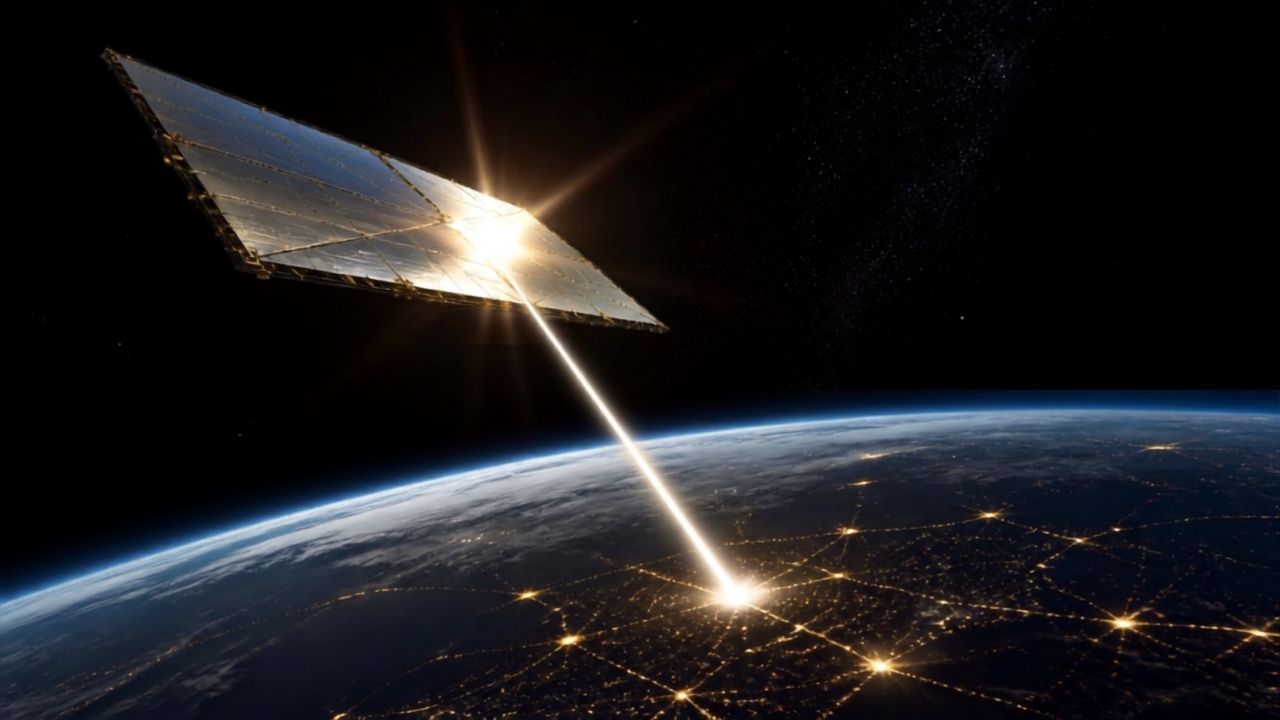
A US startup called Reflect Orbital wants to put more than 50,000 large mirrors into low Earth orbit within a decade, reflecting sunlight down to specific spots on the ground on demand — extending solar power generation into the night, lighting disaster zones, even replacing carbon-emitting street lighting. In July, the FCC approved the company’s first demonstration satellite, Eärendil-1: a 60-foot mirror at roughly 600 kilometres altitude, the first real step toward that constellation.
The catch is what the full-scale version would do to the sky. A new peer-reviewed study led by Miroslav Kocifaj and Princeton astrophysicist Gáspár Bakos calculated that one of the planned 174-foot (54-metre) operational mirrors would appear about magnitude −16.7 from the ground — roughly four magnitudes, or 40 times, brighter than the full Moon — to anyone standing inside its 3.4-mile beam, with measurable atmospheric sky-glow extending a further 20 to 34 kilometres beyond the beam’s edge. “It will be worse than big cities like London,” Bakos told reporters. “You would not see any stars if you were in the beam.” With several hundred mirrors and overlapping beams — a real possibility once the full constellation flies — combined brightness in overlap zones could reach roughly 10,000 times the full Moon.
It’s a different problem to the streaking-satellite complaints astronomers have raised about megaconstellations like Starlink for years: this is hardware built specifically to be as bright as possible, aimed deliberately at the ground. Dark-sky advocates have also flagged risks to nocturnal wildlife navigating by natural light cycles. Reflect Orbital says beams will stay contained to defined target areas, can be shut off instantly, and will avoid observatories and sensitive habitats — whether that holds at a constellation of tens of thousands of mirrors is the open question regulators, and the astronomy community, will be arguing over for years to come.
Starship: one ship comes home, the next one slips
Ship 40 — the Starship upper stage that survived an intact splashdown after Flight 13 on July 24, the first time any Starship upper stage has done so — has finally been loaded onto a heavy-lift transport vessel off Christmas Island and is now heading home to Starbase, Texas, a trip expected to take several months. The intact recovery is already feeding real heatshield and reentry data into design changes for future ships.
Meanwhile, Flight 14 has quietly slipped from its earlier late-August target to no-earlier-than September 15, according to internal SpaceX/FAA air-traffic planning documents — Ship 41 has finished its static-fire testing, but Booster 21 only rolled out to the pad this week and is now the pacing item. When it does fly, Flight 14 will attempt Starship’s first full orbital flight and deploy the newer Starlink V3 satellites, though the tower-catch attempt for the returning ship has been pushed back again, with Ship 41 instead splashing down in the ocean.
A hot, watery world on borrowed time
Astronomers led by Sylvain Breton (Italy’s National Institute for Astrophysics) have characterised HD 176071 b, an exoplanet 335 light-years away roughly 2.5 times Earth’s width and 8.5 times its mass, with a composition suggesting about 50% water. It orbits its star from just 1.5 million miles out, completing a year in 14 hours — a distance so close that extreme tidal forces are expected to eventually consume the planet entirely. It was found using a reflected-light technique, comparing archival Kepler data against newer TESS and HARPS-N observations, rather than the usual transit method.
Roman Space Telescope: the budget fight nobody told you about
With NASA’s Nancy Grace Roman Space Telescope two days from its Sunday, August 30 launch (7:26 a.m. Eastern, Falcon Heavy), today’s Launch Readiness Review is underway as this goes to air. But we wanted to tell a story we hadn’t yet: in April 2025, leaked drafts of a proposed NASA budget included the agency’s largest-ever funding cut — 24% overall, 50% to science — with no funding at all for Roman, despite the mission being 95% complete. The subsequent official budget softened that to $156.6 million, still less than half the prior year’s funding. Congress ultimately rejected the deeper cuts and restored NASA’s funding to previous levels — and Roman’s team responded by pulling the launch timeline forward from September to August 30, working double shifts and weekends to finish eight months ahead of schedule and under budget. As project manager Jamie Dunn put it: “delivering on your commitments means something.”
Tonight’s Sky
The G2 geomagnetic storm NOAA forecast for today is playing out now — aurora chances improve at northern latitudes, unlikely to reach much past Tasmania locally. Venus remains the easy target low in the west after sunset, with Saturn well placed after dark; tonight’s Moon is essentially full, having carried most of the world’s share of this week’s partial lunar eclipse through broad Sydney daylight earlier today.
Follow us: @AstroDailyPod