The Reach of a Giant
Related Episode
The Reach of a GiantWe tend to think of black holes the way we think of drains. Things fall in; nothing comes back. It is a good story, and as far as it goes, it is true. But it is barely half of what a big, actively feeding black hole does — and the other half, revealed in fresh detail this week, is arguably more astonishing.
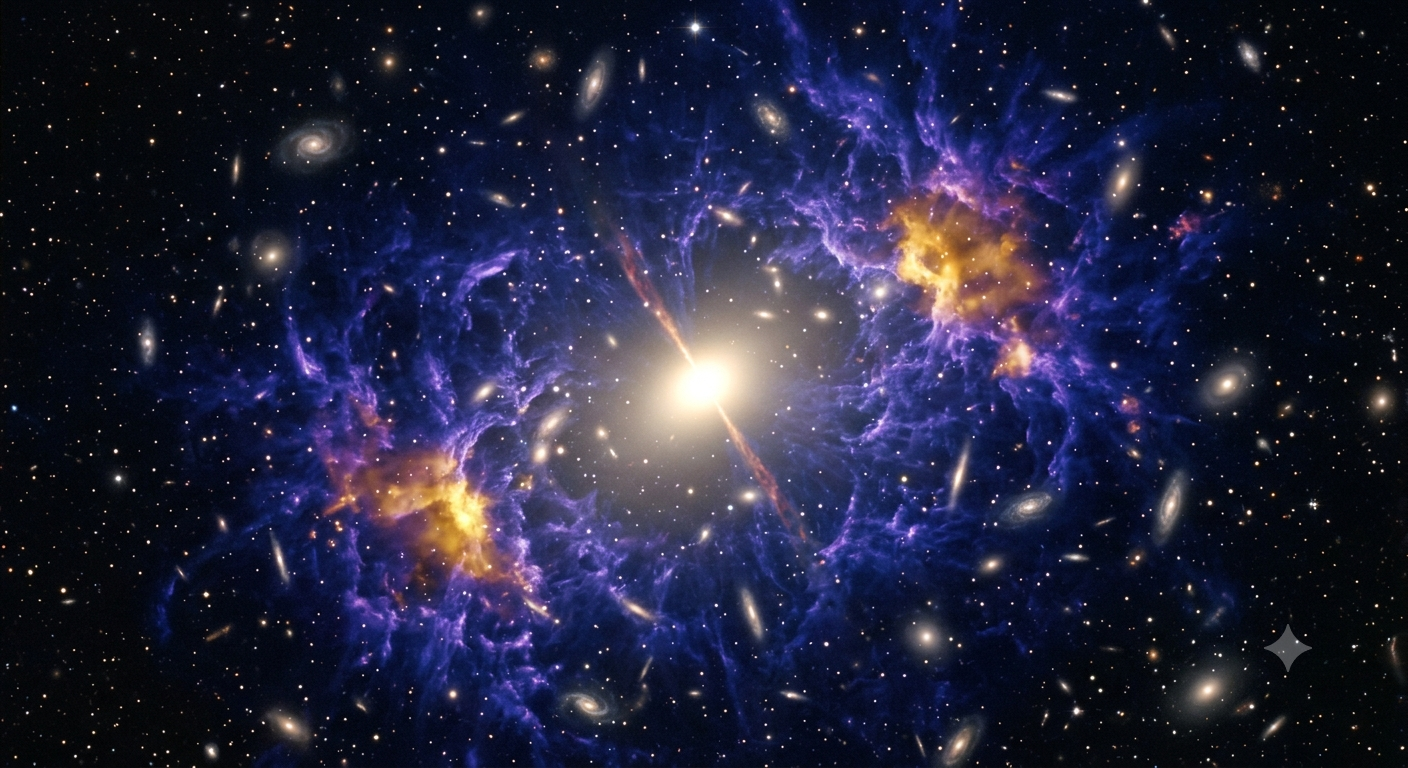
Writing in Nature Astronomy on 28 July, a team led by Satoshi Yamada at Tohoku University turned Japan’s XRISM X-ray observatory towards a rare and useful object: a quasar called H1821+643, sitting in the constellation Draco about 3.4 billion light-years away. A quasar is a black hole feeding so ferociously that it outshines its whole galaxy, and this one is a monster — around 2.6 billion times the mass of our Sun. What makes it special is its address. It lives at the very heart of a galaxy cluster, giving astronomers a rare chance to watch a raging black hole and a vast reservoir of hot cluster gas in the same frame.
That reservoir is at the centre of a long-standing puzzle. The hot gas filling a cluster core should, by the simplest physics, cool, sink and collapse into enormous numbers of new stars. Yet real cluster cores are far calmer than that. Something reheats and re-stirs the gas, holding runaway cooling at bay. For years the leading suspect has been the central black hole — the idea that its outbursts, its “feedback,” dump energy back into the gas and keep the system balanced. The trouble was the evidence stopped at the edge of the galaxy. We could see black holes driving winds on galactic scales; we could not show those winds reaching out into the space between galaxies, on the scale of the whole cluster.
XRISM changed that, because it can do something remarkable: read the motion of gas from its light. The hot gas contains iron atoms that emit X-rays at very specific, sharp energies. When the gas churns, some of it moves towards us and some away, and that motion smears the sharp emission line out — broadening it, just as a passing siren changes pitch. Measure the broadening and you have measured the turbulence. When Yamada’s team read those iron lines around H1821+643, the gas was moving far more violently than expected, and it was doing so across a staggering span of space.
The disturbance reaches roughly 300,000 light-years from the black hole — about three times the width of the Milky Way, and well beyond the host galaxy into the cluster itself. The energy bound up in that turbulence is on the order of a hundred times previous estimates. In effect, the black hole is injecting a few to ten per cent of its radiative output straight into the surrounding cluster gas, on scales of tens to a hundred kiloparsecs. This is the missing link: direct evidence of a black hole heating and stirring its cluster from the inside, exactly the mechanism theorists needed to explain why all that gas is not collapsing into stars.
Why care, beyond the sheer scale of it? Because this is really a story about how galaxies grow up. Black holes and their galaxies grow together, and feedback is the thermostat. Too little, and gas cools and the galaxy makes far too many stars; too much, and the fuel is blown away and star formation stalls. Get it right and you build the galaxies we actually observe. Yamada’s team has caught that thermostat in the act on a scale we previously had to assume — moving energy, and in time the chemical elements forged inside stars, out across an entire cluster.
It is a lovely irony to sit with. The objects most famous for pulling everything in turn out, on the grandest scales, to be reaching out — redecorating whole neighbourhoods of the universe they never physically touch. And this is only an opening chapter. XRISM is young, and objects like H1821+643 are rare. Expect more cluster cores to get the same treatment, and expect our picture of how black holes shape the cosmos to keep on growing.
And if all this cosmic reach leaves you wanting to look up: tonight, 30–31 July, two meteor showers peak together — the steady Southern Delta Aquariids and the bright, slow fireballs of the Alpha Capricornids. The Southern Hemisphere has the best seats, with the radiants riding high overhead, but a bright, near-full Moon means the fireballs are the reliable catch everywhere. Face away from the Moon, give your eyes half an hour to adjust, and watch a wide patch of sky. Clear skies.