The Night a Telescope Started Driving Itself! | Astronomy Daily · Weekend Wrap · 1 August 2026
Ask any astronomer who has worked a night at a major observatory and they’ll describe the same quiet, relentless pressure. You have the telescope for a set number of hours. The sky refuses to cooperate. Clouds drift in from nowhere; the Moon climbs and drowns your faint targets in silver; the air steadies and then turns to soup. Every few minutes you’re making a call — point here now, hold that one for later, abandon this one entirely — trying to wring the most science out of hours that will never come again. It’s a craft, learned over decades and passed down like any other.
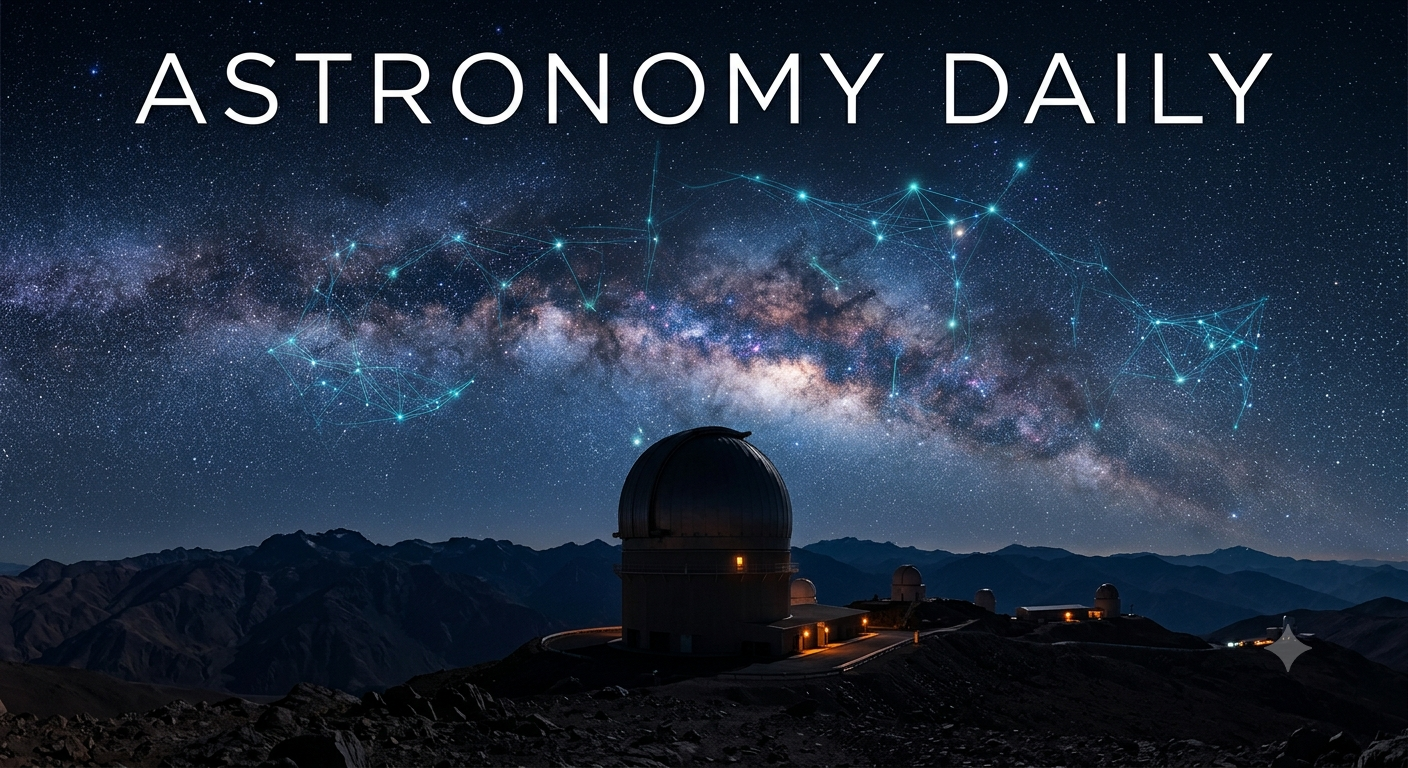
This week, a machine showed it could do that job. Scientists from Northwestern University, the University of Chicago and Fermilab — working through a research centre with the delightful name of the AI Institute for the Sky, or SkAI — deployed a deep-learning system that schedules observations on its own. And they didn’t try it on a simulator. They handed it the Dark Energy Camera, a 570-megapixel instrument mounted on the Víctor M. Blanco 4-metre telescope at the Cerro Tololo Inter-American Observatory, high in the Chilean Andes.
The result, published on 31 July, is the part worth pausing on. The AI didn’t simply generate a plan for the night and step back. It adapted that plan in real time, re-deciding where to look as the weather and the moonlight changed around it. Across two full observing runs it performed comparably to human schedulers — implicitly accounting for atmospheric conditions and lunar glare that nobody had ever written down as explicit rules.
How it learned is as interesting as what it did. The team deliberately avoided programming in the accumulated wisdom of generations of observers. Instead, as UChicago’s Alex Drlica-Wagner explained, they trained the model on years of real Dark Energy Survey nights — showing it where the telescope was pointing at one moment, asking it to predict the next, and correcting it against what the human astronomers actually chose. Guess, compare, adjust, repeat, across years of data. The system didn’t receive the recipe. It absorbed the craft.
Drlica-Wagner called it “an important milestone toward more autonomous observatories,” and stressed that the real achievement was building all the infrastructure needed to run this on a national facility — the difference between a clever demonstration and a tool you can actually use.
Why does this matter beyond the novelty? Because astronomy is about to be buried in data. The Vera Rubin Observatory, also in Chile, will image the entire southern sky every few nights for a decade, generating a firehose no human team could hand-tune fast enough. If you want to catch the universe in the act of changing — a supernova flaring, an asteroid slipping past, something simply new — the telescope has to react on the night, not follow a plan written a week earlier. Self-scheduling is how you keep up.
It’s worth being clear about what is, and isn’t, being handed over. The machine decides the “where next, right now” — which patch of sky, which filter, in what order — inside goals that humans still set. The “why” of the survey remains entirely human. And the system standing in for those astronomers learned everything it knows from them. It’s less a replacement than a tireless apprentice.
There’s a nice symmetry in where it happened, too. The Blanco has been a workhorse of Southern Hemisphere astronomy for half a century — the very telescope behind the original discovery of dark energy. Now it’s helping pioneer how the next generation of observatories will run themselves.
The rest of the week gave us plenty to talk about as well. Betelgeuse, the famous red shoulder of Orion, was finally caught with the companion star astronomers had suspected for over a century, imaged by ESO’s Very Large Telescope. Asteroid (44) Nysa turned out to be the first known three-lobed asteroid, complete with its own kilometre-wide moon. And X-ray observations of the quasar H1821+643 traced a single black hole’s influence reaching across 300,000 light-years — roughly three Milky Ways — stirring turbulence through a whole galaxy cluster.
And the sky ahead is generous. August opens with Comet 10P/Tempel 2 at perihelion on the 2nd, builds to a total solar eclipse across Greenland, Iceland, Spain and Portugal on the 12th — coinciding, remarkably, with a moonless peak of the Perseid meteor shower — and threads a six-planet line-up through the whole month. Wherever you observe from, there’s something up there for you. As always: clear skies.