The Most Interesting Result in Physics This Week Is a Non-Discovery
A detector a mile underground recorded one flash of light it cannot explain. What happened next is the part worth paying attention to.
Companion blog post for S05E185 · Friday, September 4, 2026 · 895 words · astronomydaily.io
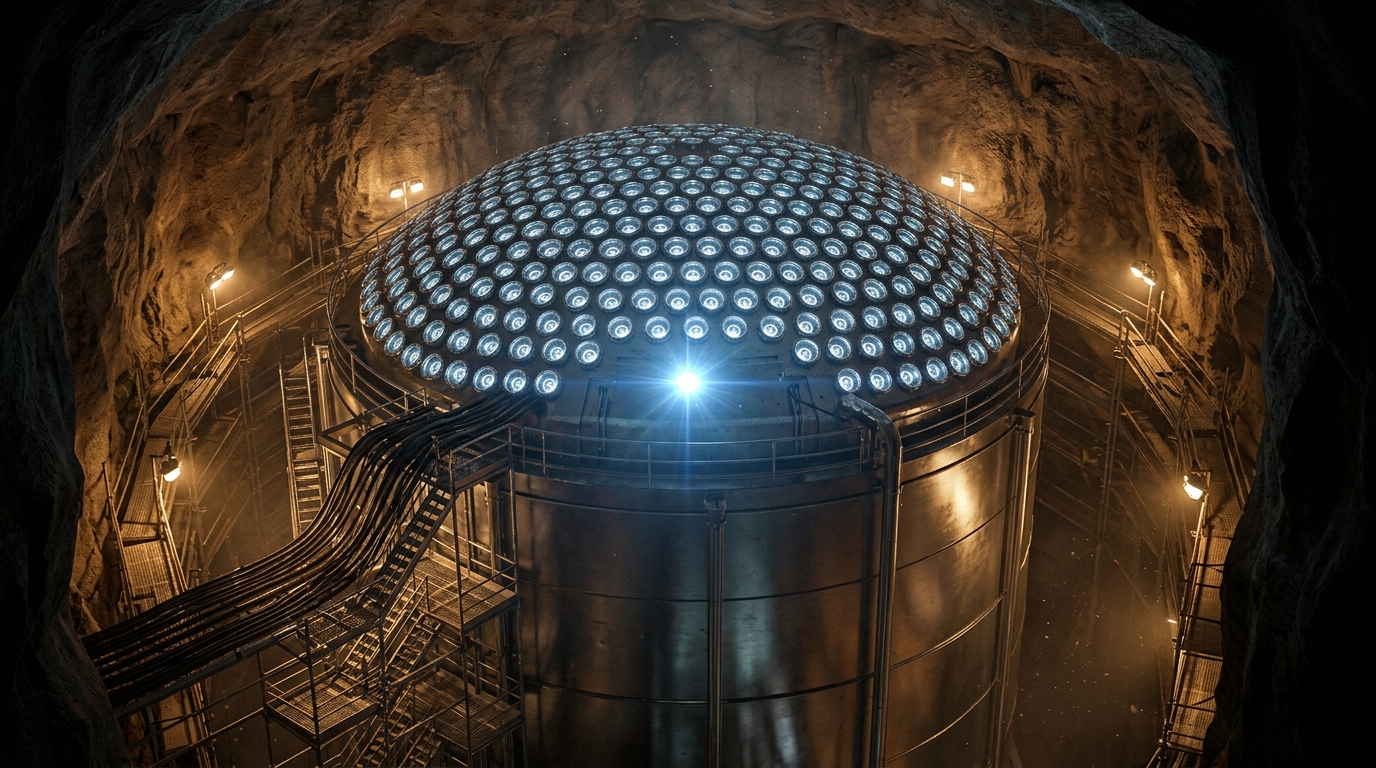
There is a tank of liquid xenon — ten tonnes of it — sitting about a mile beneath South Dakota, in a mine that used to produce gold. It is wrapped in a water tank, surrounded by a neutron veto, and built from materials screened for radioactivity to a degree that borders on obsessive. The entire purpose of the apparatus is to be the quietest place anyone has ever constructed, so that if something very rare happens inside it, you will notice.
This week the collaboration that runs it, LUX-ZEPLIN, announced that something did. In 220 days of data taken between March 2023 and April 2024, a new analysis searching a wider range of possible interactions than the standard one turned up a single event: a nuclear recoil, sitting in a region where the expected background is essentially zero, and where a dark matter particle was supposed to appear if it appeared at all. The team spent months trying to explain it away — cosmic rays, neutrons from the surrounding rock, contamination in the detector materials, instrumental artefacts — and could not.
And then they published it as an anomaly. Not a discovery. That distinction is the story.
The number attached to the event is 2.6 sigma globally, 3.4 sigma locally. Roughly, the global figure means about a half a per cent chance that known backgrounds produced it. That sounds compelling right up until you learn where the bar sits: particle physics does not use the word discovery until 5 sigma, which is about one chance in three and a half million. 2.6 is nowhere near it.
The gap between those two numbers — local and global — is the most useful idea in the whole announcement, and it is the thing almost every headline this week has left out. Local significance asks how surprising the event is at one exact particle mass and one exact energy. Global significance asks the fairer question: you searched across a whole range of masses and energies, so how surprising is it that you found one odd thing somewhere in that range? Search a bigger haystack and you should expect more strange-looking straws. Correcting for that is called the look-elsewhere effect, and the fact that LZ quoted both numbers rather than only the flattering one tells you something about how the collaboration intends to be read.
There is a further wrinkle, and it cuts both ways. The event sits at a higher energy than the simplest models predict a first signal should, implying a particle of at least 200 GeV — more than 200 times the mass of a proton — interacting in a way those models do not describe. The generous reading is that nature was never obliged to be simple, and forty years of not finding dark matter may be precisely because the tidiest places were searched first. The unkind reading is that when a result lands where no model expected one, an unmodelled background becomes a very live explanation — the reason you have not modelled it is that you did not know it was there.
This field has earned its caution. DAMA, in Italy, has claimed for more than twenty years to see a dark matter signal that rises and falls annually, and nobody else has reproduced it. XENON1T reported an excess in 2020 that caused a great deal of excitement and was most likely a trace of tritium, present at a level almost too small to measure. Being wrong publicly teaches a discipline to phrase things carefully.
What settles it is not argument but exposure. LZ has already banked substantially more data than went into this analysis and is running toward a thousand live days. If the event is real, its rate is set by physics, more will follow, and the significance climbs. If it is a fluke, it decays as exposure grows. A proposed successor, XLZD, would hold roughly ten times the xenon — at that scale a signal like this would not be one event, it would be hundreds.
There is a southern end to this story, and it is a genuinely elegant piece of experimental design. SUPL — the Stawell Underground Physics Laboratory — sits a kilometre down a working gold mine in western Victoria, the first underground physics laboratory built in the Southern Hemisphere. Its first experiment, SABRE South, moves in late this year, and its purpose is to test DAMA’s annual claim from the other side of the planet. The logic is simple: Earth’s motion through the galaxy’s dark matter halo does not care which hemisphere you stand in, but temperature, radon and cosmic-ray rates all flip with the seasons. In Italy the claimed signal peaks in summer, alongside every mundane thing that peaks in summer. Run a near-identical detector in Victoria and a real galactic signal should still peak in the same calendar month — a seasonal artefact would peak six months out.
So the honest summary of this week is not that dark matter has been found. It is that the most sensitive detector of its kind has recorded something it cannot account for, in exactly the place worth watching, and the people who found it have declined to oversell it while the data that will settle the question is already being collected. That is a good week for science, even if it is not the week.
Sources
Brown University — LZ experiment sees surprising result in search for dark matter — https://www.brown.edu/news/2026-09-01/lz-dark-matter-results
US Department of Energy — LZ Sees Surprising Result in Search for Dark Matter — https://www.energy.gov/science/articles/lz-sees-surprising-result-search-dark-matter
Imperial College London — Dark matter hunt takes unexpected turn after puzzling signal spotted in LZ detector — https://www.imperial.ac.uk/news/articles/natural-sciences/physics/2026/dark-matter-hunt-takes-unexpected-turn-after-puzzling-signal-spotted-in-lz-detector/
TeVPA 2026 — Search for high-energy dark matter interactions with the LUX-ZEPLIN experiment — https://indico-icehap.phys.s.chiba-u.ac.jp/event/3/contributions/471/
The LZ Dark Matter Experiment — collaboration site — https://lz.lbl.gov/
Space.com — Scientists may have detected the 1st direct evidence of dark matter — https://www.space.com/astronomy/dark-universe/scientists-may-have-detected-the-1st-direct-evidence-of-dark-matter
ARC Centre of Excellence for Dark Matter Particle Physics — Stawell Underground Physics Laboratory — https://www.centredarkmatter.org/supl
SABRE South — dark matter direct-detection experiment — https://www.sabre-experiment.org.au/
Phys.org — Underground lab clears crucial hurdle for dark matter hunt — https://phys.org/news/2026-04-underground-lab-crucial-hurdle-dark.html