The Moon in Five Hours
Astronomy Daily companion blog · S05E188 · Tuesday, 8 September 2026 · astronomydaily.io
For half a century the story has been that the Moon assembled slowly out of a ring of debris. A new set of simulations changed one assumption — and got a finished Moon before dinner.
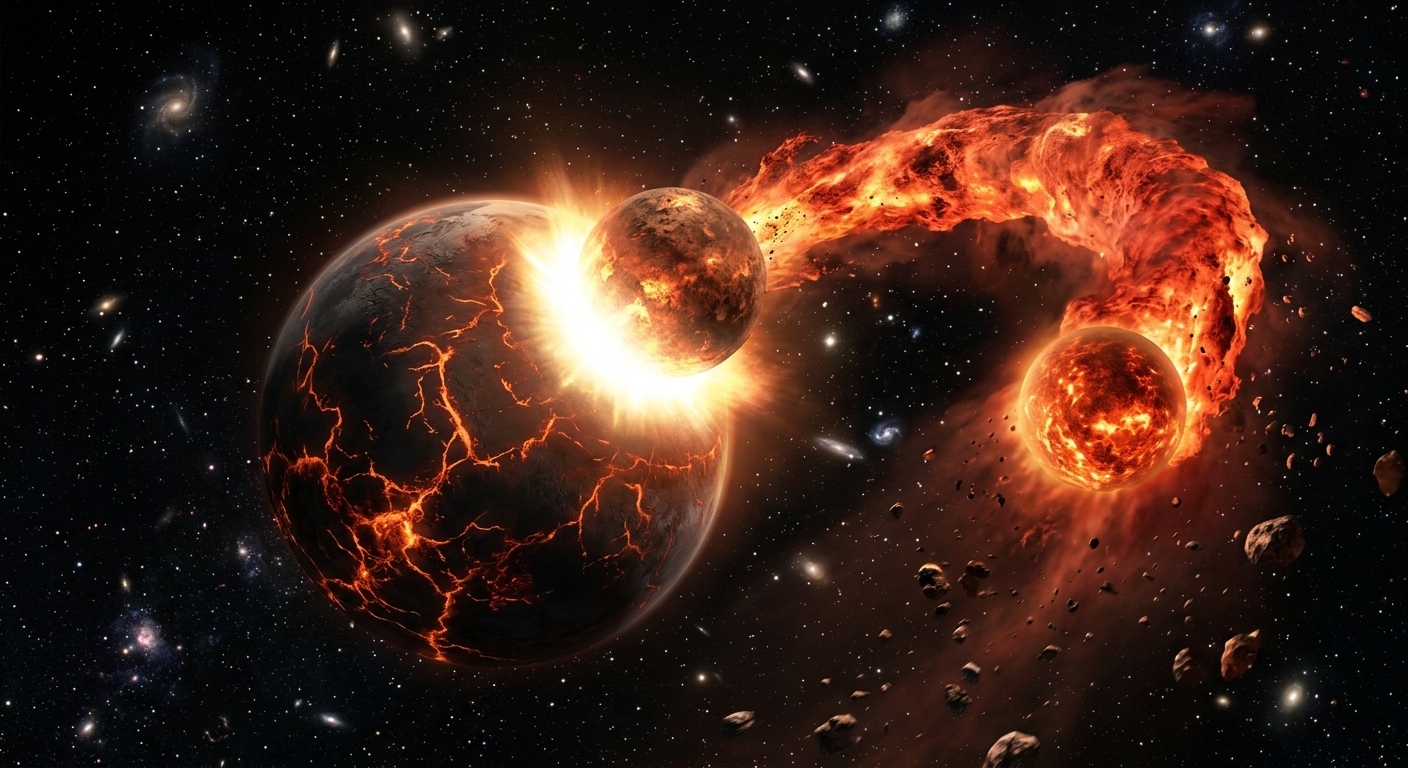
Ask how the Moon was made and you get a confident answer. About four and a half billion years ago a body roughly the size of Mars — we call it Theia — struck the young Earth a glancing blow. Theia was destroyed, a great deal of Earth’s mantle went with it, and all of that material ended up in orbit as a disc of molten and vapourised rock. Out of that disc, over somewhere between a month and a couple of hundred years, the Moon assembled itself.
That model has been the standard since the mid-1970s, and it works — with one long-standing irritation. The Moon looks far too much like Earth. Its oxygen, titanium and chromium isotopes are indistinguishable from terrestrial rock, while every other body in the solar system carries its own fingerprint, because everything formed in a slightly different part of the protoplanetary disc. But the classical model builds the Moon mostly out of Theia, so the Moon ought to look like Theia. It doesn’t. Planetary scientists call it the isotopic crisis.
The assumption nobody questioned
Now a team led by Adeene Denton at the Southwest Research Institute — with Robin Canup, one of the architects of the modern giant-impact model, and Erik Asphaug at the University of Arizona — has changed a single input. Not the impact speed, the angle, or the size of Theia. The strength of the rock.
In essentially every giant-impact simulation ever run, both colliding bodies have been modelled as strengthless fluids. That sounds absurd until you appreciate why: at the pressures involved, rock really does behave far more like a liquid than a solid, and dropping its strength from the calculation saves an enormous amount of computing time. The assumption was reasonable. It was also, it turns out, incomplete — because strength is not a fixed property. It depends on temperature. Hot rock is weak; cold rock is strong. A young Theia, still hot from its own formation, is a soft object; a Theia that has had a hundred million years to cool is a considerably tougher one.
Five hours, not five centuries
Denton’s team put temperature-dependent strength into the model and ran the canonical impact — the same parameters as the original modelling, nothing exotic. Out of one of those runs came something nobody was expecting: not a disc, but an intact Moon, in orbit around the Earth, roughly five hours after the collision.
It is worth being careful about what that means, because the headline flattens it. The finding is not that we now know the Moon took five hours to form. It is that a variable everyone had reasonably ignored can swing the outcome from one formation pathway to a completely different one — which implies decades of previous work may have been exploring only half the available possibilities.
The simulations produced two distinct outcomes, and which one you land in depends on how hot Theia was — really a question about when the impact happened. An impact less than about sixty million years after the solar system began forming meets a hot, weak Theia that comes apart completely, giving the immediate Moon, built overwhelmingly from Theia’s mantle. An impact a hundred to a hundred and fifty million years in meets a cooler, stronger Theia that survives better, merges more of itself into the Earth, and leaves the classical slow disc behind.
The Moon as a clock
That is the real prize. The date of the giant impact is one of the genuinely open numbers in planetary science, with credible estimates spanning something like a hundred million years. If the state the Moon started in depends on when it was struck, the Moon itself becomes a clock. Doing that properly needs deep lunar material, mantle or close to it — an argument for the sample return that Artemis and the Chinese south pole missions are building towards.
The caveats are the authors’ own: this is a simulation rather than an observation, the strength model for rock under those conditions is itself an approximation, and they ran the canonical case rather than the full parameter space.
A deadline in the Murchison
There is also a hard limit on the late branch of this story, and it sits about four hundred kilometres inland from Geraldton in Western Australia. The Jack Hills, in the Narryer Gneiss Terrane, hold the oldest known fragments of the Earth: zircon crystals a fraction of a millimetre across, dated to roughly 4.4 billion years. Zircons survive almost anything, and what those grains tell us is that by 4.4 billion years ago the Earth already had a solid crust and, on the isotopic evidence, probably liquid water. An impact that turns the entire surface into a magma ocean has to be older than that — which means the constraint on how the Moon was born is sitting in a creek bed in the Murchison.
Denton, Canup and Asphaug’s paper appears in The Astrophysical Journal Letters; SwRI announced the result on 1 September 2026. You can hear the full discussion in Astronomy Daily S05E188, out today.