The Hydrogen Map: A Desert Telescope Just Made Dark Energy Measurable by Radio
Related Episode
The Hydrogen Map: How a Radio Telescope Heard Half the UniverseMeerKAT has detected hydrogen from four to five billion light years away using radio data alone — with 96 hours of observing recorded back in 2018. Here is why that is a bigger deal than it sounds.
Companion blog post for S05E186 · The Weekend Wrap, Saturday, September 5, 2026 · 982 words · astronomydaily.io
There is a wavelength at which the most common substance in the Universe quietly announces itself. Twenty-one centimetres. A neutral hydrogen atom occasionally flips the spin of its electron and gives up a single photon at that exact wavelength, and it has been the most dependable signpost in astronomy for seventy years — because it is indifferent. Hydrogen does not care whether it sits in a spectacular spiral or a formless dwarf. If it is neutral, it glows.
In principle that makes it the ideal way to find where matter actually is. In practice, the emission from any individual galaxy billions of light years away is hopelessly faint. So about fifteen years ago cosmologists proposed giving up on individual galaxies altogether: point the telescope at a wide patch of sky, deliberately throw away resolution, and measure the combined glow of everything inside that volume.
That blurry map is a map of the cosmic web, because hydrogen lives in galaxies and galaxies live in the web. The technique is called hydrogen intensity mapping, and its appeal is economic as much as scientific. Optical surveys identify galaxies one at a time and measure each one’s distance — superb work, and enormously expensive in telescope time. Intensity mapping only needs to know how much hydrogen sits in this cube of space versus that one. Do that across a large enough volume and a long enough stretch of cosmic history and you are measuring how the expansion of the Universe has changed — which is to say, you are measuring dark energy.
The obstacle has always been the foreground. Our own Milky Way emits radio waves — synchrotron radiation from electrons spiralling through the galaxy’s magnetic field — at something like ten thousand times the brightness of the cosmological signal underneath it. Add human radio interference from satellites, aircraft and phones, then add the telescope’s own systematics, which have an unhelpful habit of imprinting patterns on the data that look a little like signal. As Dr Sourabh Paul of the University of Manchester and the University of the Western Cape put it in announcing this week’s result, the signal is extremely faint and difficult to isolate from foreground emission, human-made radio-frequency interference, and instrumental effects.
Every previous detection has dealt with that by leaning on somebody else’s data. You take your radio map and cross-correlate it with an optical galaxy survey covering the same patch of sky. You already know where the galaxies are; you simply ask whether the radio map brightens in those places. It is a legitimate detection, and MeerKAT has made them before. But the contamination and the noise do not know where the optical galaxies are, which means they average away — and that is both the method’s strength and its ceiling. You are permanently tethered to an optical telescope.
This week, a team led by Paul, with Dr Laura Wolz at Jodrell Bank, Prof Mário Santos at the Western Cape and Dr Zhaoting Chen at Edinburgh, published a detection in The Astrophysical Journal Letters that cuts the tether. The twenty-one centimetre signal, measured in MeerKAT’s radio data alone. No optical survey underneath it. The foregrounds were not dodged; they were removed. The emission has been travelling for four to five billion years, from an era when dark energy had already taken hold and the expansion was accelerating — precisely the epoch you want to probe.
Two details make the result better than it first sounds. The first is that it took about ninety-six hours of telescope time. Four days. The second is Santos’s line, which is the one I keep returning to: it is particularly remarkable that the data used in this study were taken in 2018, when MeerKAT had only just started science operations. This is not a new observing campaign. It is a new analysis of some of the very first science data the array produced. The telescope was always capable of this. The difficulty was never the hardware.
The caveats are real and worth stating. This is a detection of the signal, not yet a precision measurement of cosmology — the error bars are wide, and the road from here to competitive constraints on dark energy is a long one. And twenty-one centimetre cosmology is a field that has had claimed detections walked back before; foreground removal is exactly the sort of problem that can quietly manufacture a signal out of nothing. The reason this result is being taken seriously is the groundwork underneath it. The same technique had already found the signal the safe way, in cross-correlation, before anyone went looking for it the hard way. That is the correct order to do things in.
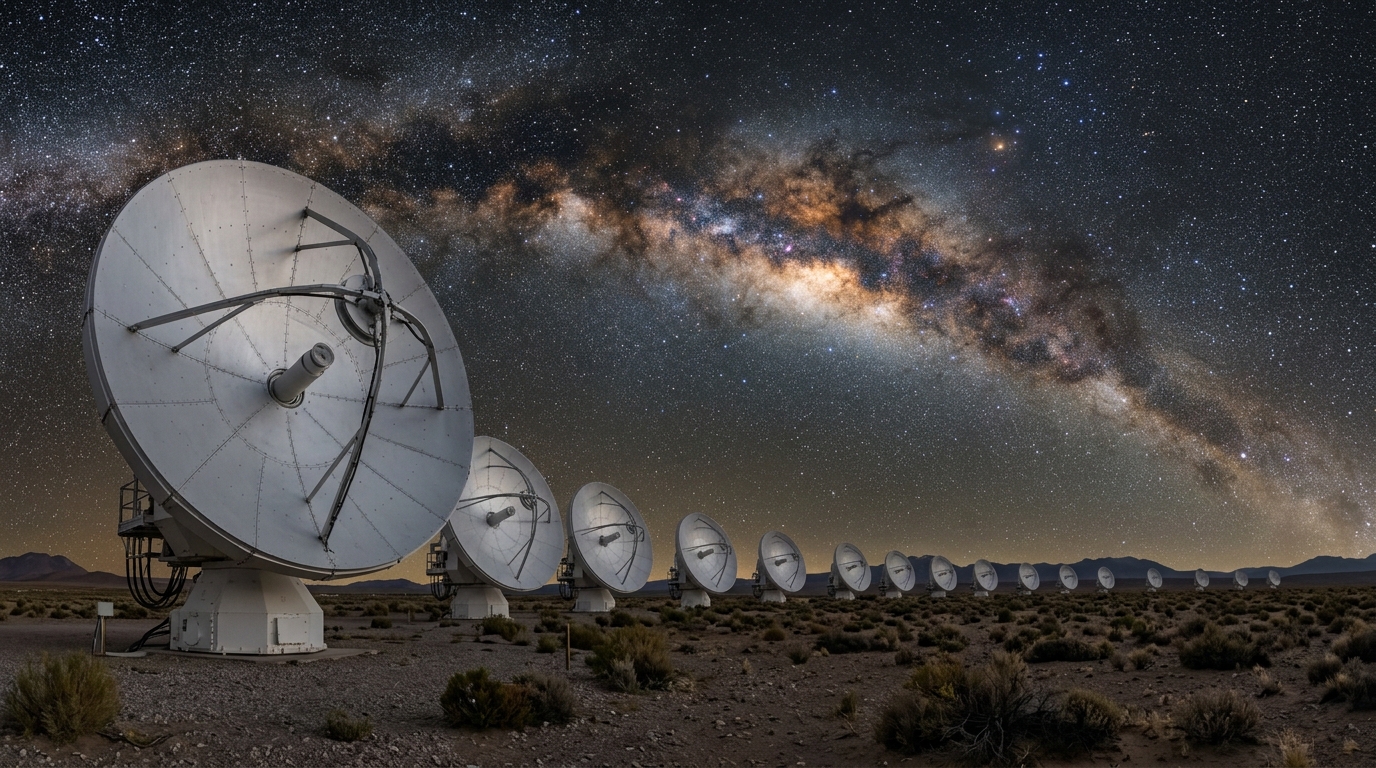
And then there is the geography, which is not incidental. MeerKAT’s sixty-four dishes stand in South Africa’s Karoo, and it is a precursor — it will be absorbed into SKA-Mid, the mid-frequency half of the Square Kilometre Array. The other half, SKA-Low, is rising at Inyarrimanha Ilgari Bundara, the CSIRO Murchison Radio-astronomy Observatory in Western Australia, on Wajarri Yamaji country. Both halves of the instrument that will carry this technique forward sit in the Southern Hemisphere, for a physical reason rather than a political one: a signal this faint cannot be heard from a continent full of radio noise. It needs legally protected silence, and these are two of the few places on Earth that have it.
So the honest summary of the week is not that we have measured dark energy with radio waves. It is that the method by which we intend to has just been demonstrated to work on its own two feet, using four days of eight-year-old data, from a desert in the south. Paul’s own framing is the right one to end on: detecting it directly with MeerKAT shows that this technique is becoming a practical tool for cosmology. Not a promising idea any more. A tool.
Sources
• University of Manchester — Astronomers use MeerKAT to directly detect faint hydrogen signal from the distant Universe — https://www.manchester.ac.uk/about/news/astronomers-use-meerkat-to-directly-detect-faint-hydrogen-signal-from-the-distant-universe
• The Astrophysical Journal Letters — Paul, Wolz, Santos, Chen et al. (paper DOI) — https://doi.org/10.3847/2041-8213/ae808f
• American Astronomical Society — release listing — https://aas.org/node/730547
• Phys.org — MeerKAT directly detects faint hydrogen signal from the distant universe — https://phys.org/news/2026-09-meerkat-faint-hydrogen-distant-universe.html
• Space.com — Scientists detect signals of hydrogen from billions of years ago — https://www.space.com/astronomy/galaxies/scientists-detect-signals-of-hydrogen-from-billions-of-years-ago-could-this-help-us-map-out-the-universe
• Xinhua — MeerKAT in South Africa directly detects faint hydrogen signal from distant universe — https://english.news.cn/africa/20260905/3f6c7164a4404b0a9b79f879b1d31a59/c.html
• SKA Observatory — the construction journey (SKA-Mid, Karoo; SKA-Low, Murchison) — https://www.skao.int/en/explore/construction-journey