The Hardest Planet to Reach Is Also One of the Closest
Today BepiColombo throws away the module that carried it for eight years. Here is why arriving at Mercury is so much harder than getting there.
Companion blog post for S05E184 · Thursday, September 3, 2026 · 830 words · astronomydaily.io
There is a particular kind of space story that sounds like bad news and isn’t. Today, somewhere between the Sun and the planet Mercury, a spacecraft is deliberately discarding the module that has done all its driving for the past eight years. That’s the good news. It means the arrival has started.
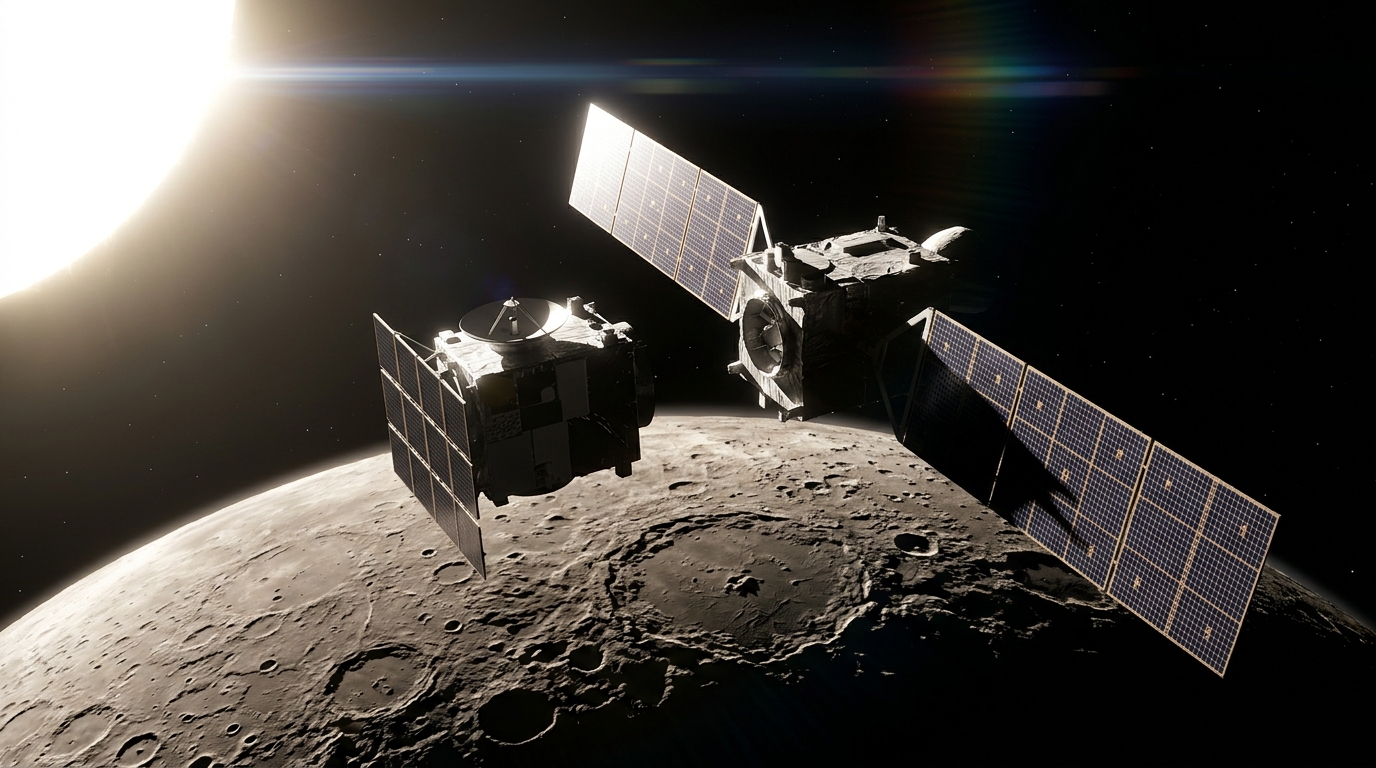
BepiColombo is a joint mission of the European Space Agency and Japan’s JAXA, and it has flown as a stack of three: a transfer module carrying the ion engines and the enormous solar wings, and, riding on top of it, two science orbiters — Europe’s Mercury Planetary Orbiter and Japan’s Mio. Today, at around 8:00am US Eastern time — about ten o’clock tonight in Sydney — the transfer module separates. ESA is covering it live, and the moment that actually matters comes about an hour later, when a ground station hears a clean signal from a spacecraft that has just become independent.
The obvious question is why any of this took eight years. Mercury is not far away. At its closest it is nearer to Earth than Venus ever gets. And yet only two missions have ever visited it: Mariner 10, which flew past three times in 1974 and 1975, and MESSENGER, which orbited between 2011 and 2015. Mars, considerably further out, has had dozens.
The answer is that reaching Mercury is not a travel problem. It is a braking problem. Aim a spacecraft inward and the Sun’s gravity does not politely deliver you — it pulls, and you accelerate the whole way down. By the time you reach Mercury’s orbit you are moving far too fast for a small planet with weak gravity to capture you; you would sail straight past. So the entire flight profile is built around shedding speed: one flyby of Earth, two of Venus and six of Mercury itself, the last in January 2025, plus years of feather-light thrust from the ion engines.
The mission is named for the man who made that approach thinkable. Giuseppe Colombo — Bepi to everyone — was an Italian mathematician who realised in 1974 that Mariner 10’s trajectory could be shaped to produce repeat encounters rather than a single pass. He also explained why Mercury rotates exactly three times for every two orbits it makes around the Sun. It is a rare and rather lovely thing for a spacecraft to carry the name of the person whose maths it is flying.
The eight years were not entirely to plan. In April 2024 engineers found unexpected electric currents running between the transfer module’s solar arrays and one of its power distribution units, starving the electric thrusters of power. Months of work recovered performance to around ninety per cent of specification, which sounds like a good result and wasn’t quite good enough. Mission manager Santa Martinez said at the time that the thrusters would remain below the minimum thrust needed for the insertion planned for December 2025. The arrival was redesigned, and Mercury slipped eleven months to November 2026.
What follows today is not a dramatic burn but a long, deliberate settling-in. Mercury’s gravity takes hold of both orbiters on 21 November. Around 9 and 10 December, Mio is released into its own highly elliptical orbit, reaching out past eleven thousand kilometres — the shape you need to study a magnetic field and the charged particles moving through it. The European orbiter then works down to a much tighter path, roughly 480 to 1,500 kilometres, arriving on 10 March 2027. Routine science begins on 6 April 2027.
And there is a great deal to look at. Mercury has a global magnetic field, which a small, long-cooled world has no business having; of the rocky planets, only Earth manages the same trick. Its iron core occupies something like eighty-five per cent of its radius — less a rocky planet with a core than a metal ball in a thin rocky coat. There is water ice in permanently shadowed craters at its poles, on the planet closest to the Sun. And MESSENGER found strange bright depressions called hollows, with no impact or volcanic explanation, which appear to be forming right now as volatile material sublimates out of the ground. A dead little world that is still, quietly, changing.
There is an Australian thread in this too, as there often is. ESA tracks its deep-space missions through a network that includes New Norcia, north of Perth in Western Australia, where a new deep-space antenna was inaugurated with CSIRO in October 2025. Southern Hemisphere ground stations are not a diplomatic courtesy on missions like this. They are how a spacecraft stays in contact while the Earth turns underneath it.
So there is nothing to see today, in the sense of pictures. What there is instead is a carrier signal arriving from something that, an hour earlier, did not exist as an independent spacecraft — and the quiet confirmation that after eight years of falling carefully toward the Sun, BepiColombo is finally on approach.
Sources
● ESA — Media briefing: BepiColombo’s next milestone towards Mercury — https://www.esa.int/ESA_Multimedia/Videos/2026/08/Media_briefing_BepiColombo_s_next_milestone_towards_Mercury
● ESA — BepiColombo mission overview — https://www.esa.int/Science_Exploration/Space_Science/BepiColombo
● JAXA ISAS — Change in arrival time for BepiColombo — https://www.isas.jaxa.jp/en/topics/003812.html
● Space.com — BepiColombo begins Mercury arrival phase, watch live Sept. 3 — https://www.space.com/space-exploration/launches-spacecraft/bepicolombo-mission-begins-mercury-arrival-phase-esa-jaxa
● SpaceNews — ESA delays BepiColombo orbital insertion because of thruster problem — https://spacenews.com/esa-delays-bepicolombo-orbital-insertion-because-of-thruster-problem/
● NASA — NASA Selects Blue Origin as Mars Telecommunications Network Provider — https://www.nasa.gov/news-release/nasa-selects-blue-origin-as-mars-telecommunications-network-provider/