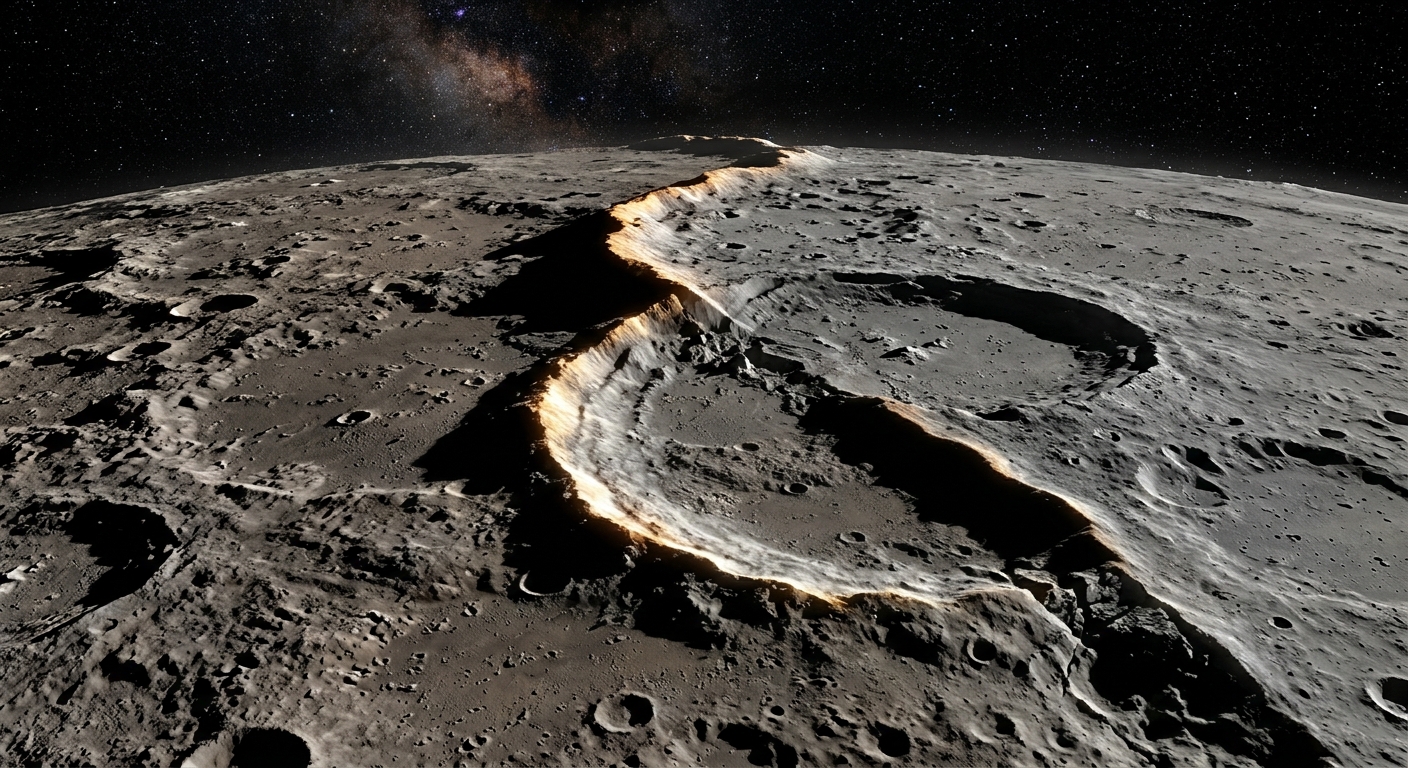
The Gravel Hiding the Ruts
Related Episode
The Planet That Keeps Shrinking plus the Weekend WrapMercury has lost more of itself than anyone had measured — and the reason we missed it is the most interesting part of the story.
There is a particular kind of scientific result I find more satisfying than a discovery, and this week Mercury supplied one. It isn’t the finding of a new thing. It’s the finding of an old mistake, together with a clean explanation of why everybody kept making it.
Mercury is shrinking, which isn’t news — it has been the textbook case of a contracting planet for half a century. Small planet, enormous iron core, and as that core has cooled over four and a half billion years the inside of the planet has been getting smaller. The rigid outer shell has to keep up, and a solid shell cannot deflate gracefully. It breaks.
What you get when it breaks are cliffs — thrust faults where one slab of crust has ridden up over another, leaving a long sinuous escarpment with a lobed front, sometimes a kilometre high and hundreds of kilometres long. Mariner 10 photographed them in 1974 and they are everywhere. Discovery Rupes, the famous one, runs five hundred kilometres and cuts straight through older craters, shoving their rims out of alignment.
And here is the elegant part: those cliffs are a measuring instrument. Each fault has absorbed a certain amount of horizontal shortening, estimable from the height of the scarp and the angle the fault dips at. Map every shortening structure, total it up, and you have measured how much diameter the planet has lost. The answer, for years, was four to sixteen kilometres — and it had a problem everybody knew about. It was too small. Model Mercury’s thermal history and the physics predicts more contraction than the surface appears to record.
When two lines of evidence pull against each other like that, either your model is wrong or you are not seeing all the evidence. New work led by Gaku Nishiyama at the German Aerospace Center in Berlin, published in Geophysical Research Letters and released by the American Geophysical Union on 10 September, argues for the second — and the reason is almost embarrassing in its simplicity. The craters have been burying the cliffs. Every asteroid that hit Mercury threw out a blanket of pulverised rock, and a sharp kilometre-high cliff under that debris gets softened, partly filled, broken into fragments that no longer read as one structure.
What lifts this from plausible to convincing is how they showed it. Using MESSENGER imagery, they built high-resolution three-dimensional terrain by stereophotogrammetry — the parallax trick your two eyes use for depth perception, applied to a planet — then measured surface roughness independently and asked whether the number of visible shortening structures depends on how battered the surrounding ground is.
It does, strongly. The rougher the terrain, the fewer scarps per unit area. And there is no physical reason the interior should have contracted less beneath rough ground than smooth — faults do not know what the surface above them looks like. So the correlation is not geology. It is a detection limit, and its strength lets you estimate how much has been erased. Nishiyama’s analogy is freshly laid gravel hiding the ruts in a road. The ruts are still there. You simply cannot see them from a moving car.
Corrected, Mercury’s contraction rises by ten to thirty per cent — the lost diameter going from a range topping out near sixteen kilometres to as much as twenty-three. On a planet 4,900 kilometres across that is a fraction of a per cent, so the number matters not for its size but for what it constrains: a larger metal core, or a purer one with fewer light elements mixed in, or simply a hotter beginning. And the mismatch with the thermal models closes. Nishiyama says the corrected figure actually makes sense to him, which is a better endorsement than a bigger headline.
Best of all, it is testable soon. BepiColombo reaches gravity capture at Mercury on 21 November, with its European orbiter in its final science orbit by 10 March. It carries a laser altimeter precise to tens of centimetres and — just as importantly, and far less often mentioned — a much less eccentric orbit than MESSENGER’s, meaning even coverage of both hemispheres. If the missing contraction really is buried small scarps, it should find them in exactly the rough ground where today’s maps look suspiciously empty. If it looks and they are not there, the correction is wrong.
Some of that data will come home through a paddock in Western Australia. ESA’s New Norcia station, run with CSIRO, holds the agency’s first deep space antenna and a newer thirty-five metre dish built for missions of this generation. Continuous contact needs dishes spread around the Earth in longitude, which means southern stations. In deep space communications the Southern Hemisphere is not a courtesy. It is load-bearing.
And it was the third time in one week. M74 turned out to be more than twice its catalogued size, because that size was really a statement about how deep the survey went. Magnetars turned out to be half of all neutron stars rather than one in a hundred, because the catalogue counted how long each kind stays visible rather than how many are born. Now a planet that has shrunk by more than the map says. Before you ask what the universe is doing, ask what your instrument is letting you see.
The full discussion — along with the week that was, new evidence that our own Sun has the magnetic energy budget for a superflare, and a Type Ia supernova in Pegasus you can find with an eight-inch telescope — is in this week’s Weekend Wrap. Listen at astronomydaily.io.