The Edge of Everything: how astronomers finally measured the universe's largest galaxy
Related Episode
The Largest Galaxy in the Universe, Measured at LastAstronomy Daily · 3 August 2026
There is a question children ask and physicists never quite stop asking: how big can one thing get? This week, astronomers came closer than ever to answering it for galaxies — by finally measuring the edge of the largest one we know.
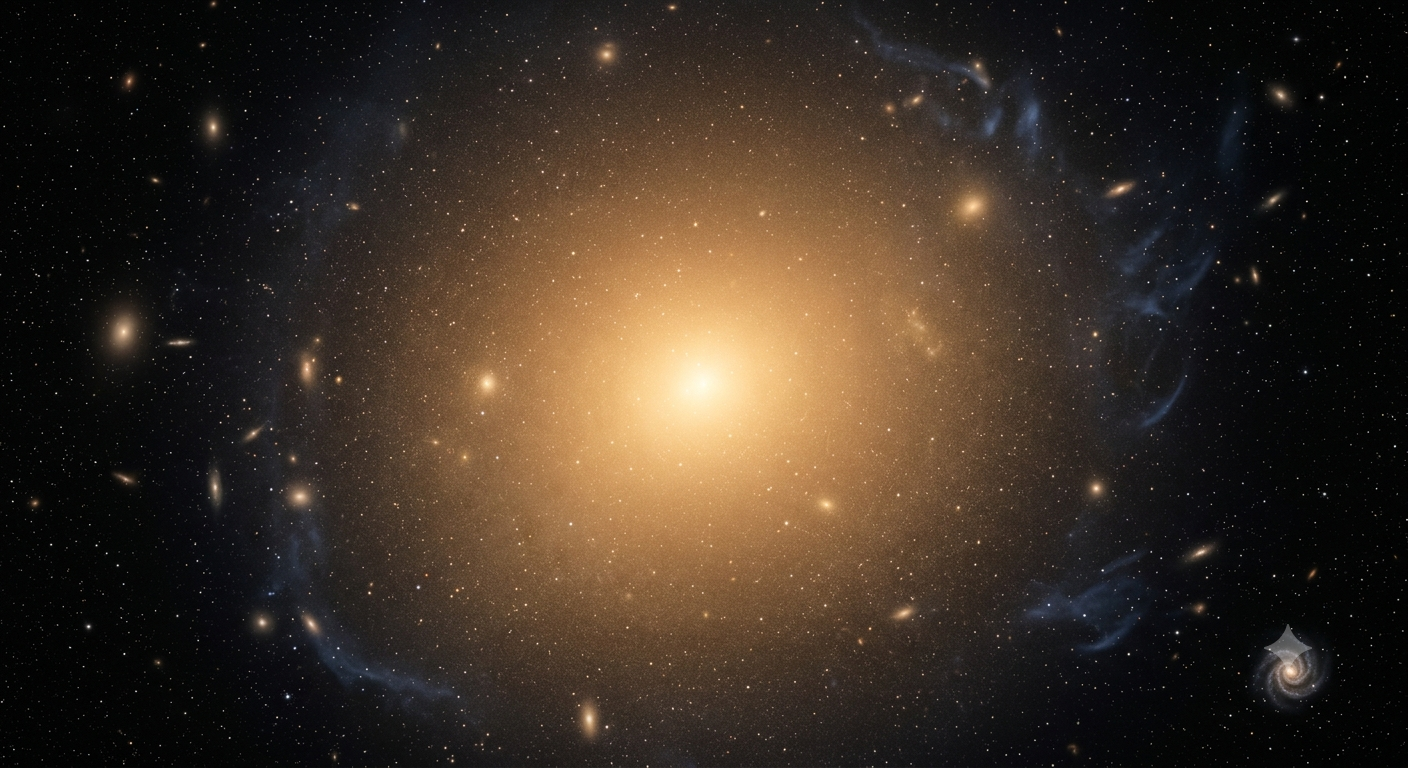
That galaxy is IC 1101, a giant sitting at the heart of a cluster called Abell 2029, about 1.15 billion light-years away. William Herschel logged it in 1790, long before anyone understood that the faint smudge was an island of stars in its own right. For decades it has worn the crown of “largest known galaxy.” The awkward secret is that, until now, nobody could say where it actually ended.
The reason is baked into how galaxies like IC 1101 grow. It is a brightest cluster galaxy — a BCG — the kind that sits at a cluster’s centre and swells over billions of years by swallowing its neighbours. Every meal leaves a residue: stars torn loose and flung into a vast, dim halo that fades so gradually it blurs into the glow of the cluster itself. Ask where the galaxy stops and the honest answer has long been a shrug. Published sizes have ranged from a modest 400,000 light-years to a headline-grabbing six million — a fifteen-fold disagreement that says more about the difficulty than the object.
A team led by Carlos Marrero-de la Rosa set out to settle it. Using the Isaac Newton Telescope’s wide-field camera, they gathered the deepest images ever taken of IC 1101, in two colours, reaching a surface brightness of thirty magnitudes per square arcsecond — sensitive to starlight roughly a billion times fainter than the sky you see on a dark night. The hard part isn’t only capturing that whisper of light; it’s separating it from the scatter of bright foreground stars and the galaxy’s own glare. So they modelled all of that stray light in detail and subtracted it, then traced the galaxy’s true profile outward until it dissolved into the background.
The verdict: IC 1101 reaches an edge about 260,000 light-years from its centre, giving a diameter near 520 kiloparsecs — about 1.7 million light-years — and holding roughly 3.4 trillion suns’ worth of stars. For scale, the Milky Way is about 100,000 light-years across and, dark matter included, weighs perhaps one to one-and-a-half trillion solar masses. IC 1101 is some seventeen times wider, with more than three trillion solar masses in stars alone. By any measure we can now defend with real data, it is the largest galaxy known.
The second finding may be the better one. Beyond that main edge, the team picked out eight faint, lopsided structures — and two of them line up with disturbances already seen in the cluster’s hot X-ray gas. That is the signature of a galaxy still feeding, probably still digesting a collision with another group of galaxies two to three billion years ago. The record-holder isn’t finished.
That is what lifts this above trivia. The paper’s real question is how large galaxies can get at all, and IC 1101 now sits at the extreme upper edge of the mass–size relation — the largest edge yet measured for any galaxy. It is, in effect, a marker planted near the ceiling of what the present-day universe can build. And it is still reaching for it.
It was not the only headline this week. Japan’s Hayabusa2 — the probe that returned samples of asteroid Ryugu in 2020 — flew just 400 metres above a near-Earth asteroid named Torifune, the closest asteroid flyby ever attempted, and pulled off the first laser ranging of an asteroid during a pass. Torifune turned out to be a contact binary, a rocky snowman. In the UK, Rocket Factory Augsburg de-stacked its RFA One at SaxaVord Spaceport after finding a fault on the pad, delaying what would be the first orbital launch from British soil; its window opens on 10 August. And closer to home, a new Hubble study found that our neighbour Andromeda has been winding down its star formation for 500 million years, perhaps jostled by its small companion M32.
Two galaxies frame the week, then: one still growing at the edge of what’s possible, one quietly settling into old age. Between them, a fridge-sized spacecraft threading a needle beside an asteroid, and a rocket waiting on a windswept Shetland pad. The sky, as ever, is busy — and this week it reminded us that even the biggest things have an edge, if you look faint enough to find it.
Clear skies.