The Crater Makers
A lost rocket comes home to the Moon tomorrow — and it’s in good company. This week, the cosmos is all about impacts.
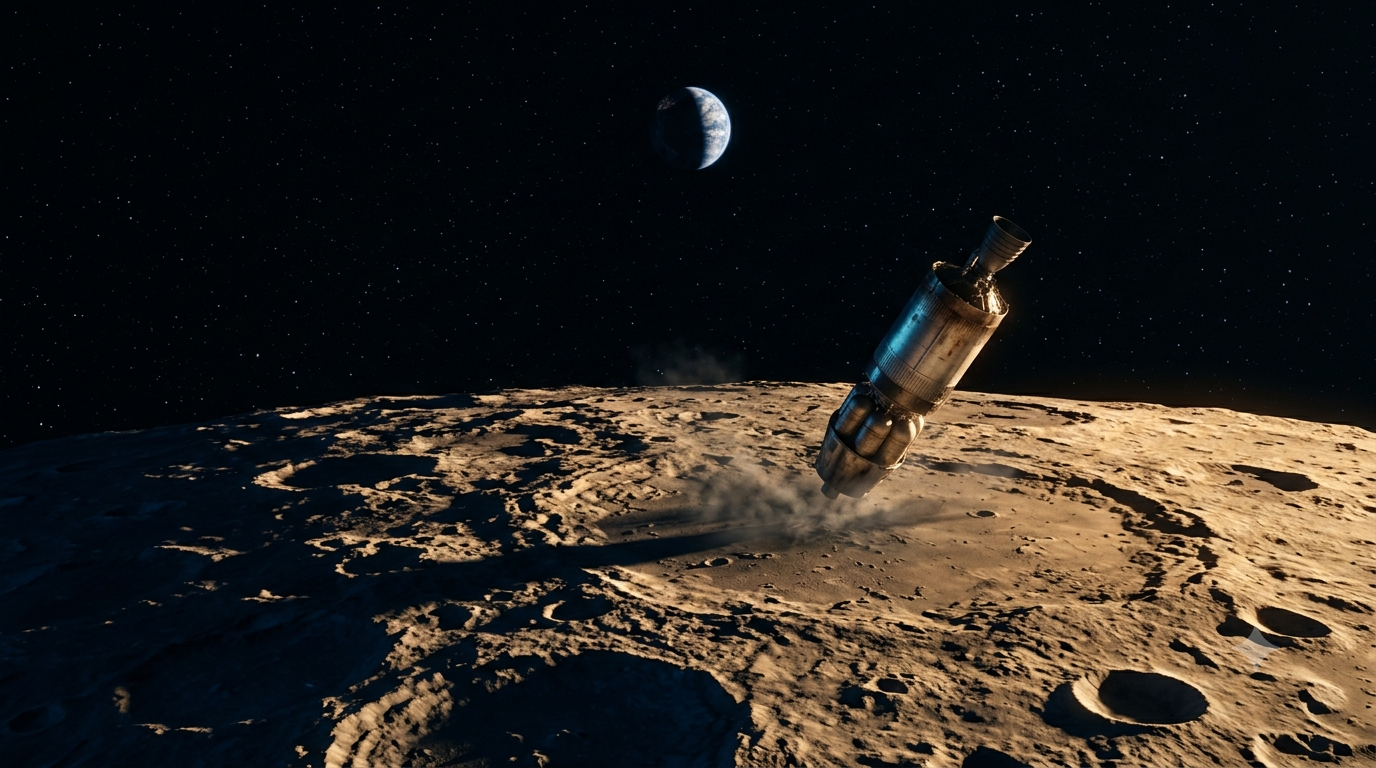
Sometime early on Wednesday morning, Universal Time, a piece of a rocket that has been drifting through space for a year and a half is going to hit the Moon. It will arrive near Einstein Crater, on the Moon’s far western edge, at about five and a half thousand miles an hour, and it will carve out a fresh crater perhaps twenty metres across. Nobody planned this. Nobody can stop it. And that combination — an accident we can see coming, precisely — is exactly what makes it so scientifically valuable.
The object is the spent upper stage of a SpaceX Falcon 9, catalogued with the unlovely name 2025-010D. In January 2025 it did an honest day’s work, launching two Moon-bound landers — Firefly’s Blue Ghost and ispace’s Resilience — before being left stranded: too high to fall back to Earth, too slow to escape. For eighteen months it wandered a chaotic loop shaped by the pull of the Earth, the Moon and the Sun, and even the feather-light pressure of sunlight. The independent astronomer Bill Gray, who runs Project Pluto, tracked it the whole way, and around March realised the numbers had stopped saying “close” and started saying “hit.”
Because we know the mass, the speed and the moment of impact so well, this becomes a rare natural experiment. NASA’s Lunar Reconnaissance Orbiter can photograph the spot before and after, and Gray can hand its team a pinpoint to aim at. A roughly two-dozen-author campaign is coordinating observers to try to catch the ejecta plume — though, to be honest, that plume is a long shot even for advanced amateurs, and there’s no flash to see with the naked eye. The Americas, north and south, are best placed for the timing; from Sydney the Moon is below the horizon, so for us it’s a story told afterward, in orbiter images.
There’s a sting in the tail, too. This is only the second uncontrolled rocket impact we’ve ever documented on the Moon — the first left twin craters on the far side in 2022. As commercial lunar traffic climbs toward permanent-base ambitions, the junk drifting through cislunar space is climbing with it, and unlike low-Earth orbit, there’s no agreed international rulebook for tracking or disposing of these stages. One new crater; one old problem, suddenly concrete.
It is, fittingly, a week of impacts. Out at Neptune, the James Webb Space Telescope has been studying the planet’s small inner moons — and found clay minerals on them. Clays need liquid water, and had never been seen beyond Jupiter, so their presence is a message from the deep past: the material came from far larger, water-bearing worlds. The leading reading, from a Caltech team led by Ryleigh Davis, is that Neptune once had an orderly moon system that was destroyed when Triton — a captured Kuiper Belt object on a tell-tale backwards orbit — arrived and shattered it. The little moons we see today are the reassembled shrapnel.
Closer to home, and closer to the bone, a new study revisits the asteroid that ended the dinosaurs. The familiar story is slow: dust blots out the Sun and an “impact winter” starves the world over years. But researchers at Purdue argue the first hours were savage. Ultrafine dust, they find, would have trapped the heat of falling debris like an insulating blanket, driving surface temperatures about three and a half times higher than earlier models suggested — enough to ignite wildfires worldwide and, in their memorable framing, charbroil exposed animals within hours. The honest caveat: the clearest fire evidence is still confined to North America.
And then, to zoom all the way out, the eROSITA X-ray telescope has released its second great data set — nearly two million cosmic X-ray sources, roughly doubling its previous catalogue and dwarfing the 130,000 that the ROSAT survey found in the 1990s. Buried in that abundance is a thirty-year answer: a census of close binary stars complete enough to explain the mysterious X-ray glow of our own galaxy’s disk. From a single rocket crater to a map of the hot Universe, in one episode.
So look up this week. Comet 10P/Tempel 2 is having its finest showing of the century, best seen from the Southern Hemisphere; Venus threads between Regulus and Spica in the evening; and the twelfth of August brings a total solar eclipse, a moonless Perseid peak and a six-planet alignment all at once. Just remember, when that eclipse comes: outside the brief moments of totality, certified ISO 12312-2 eclipse glasses, every time. Clear skies.