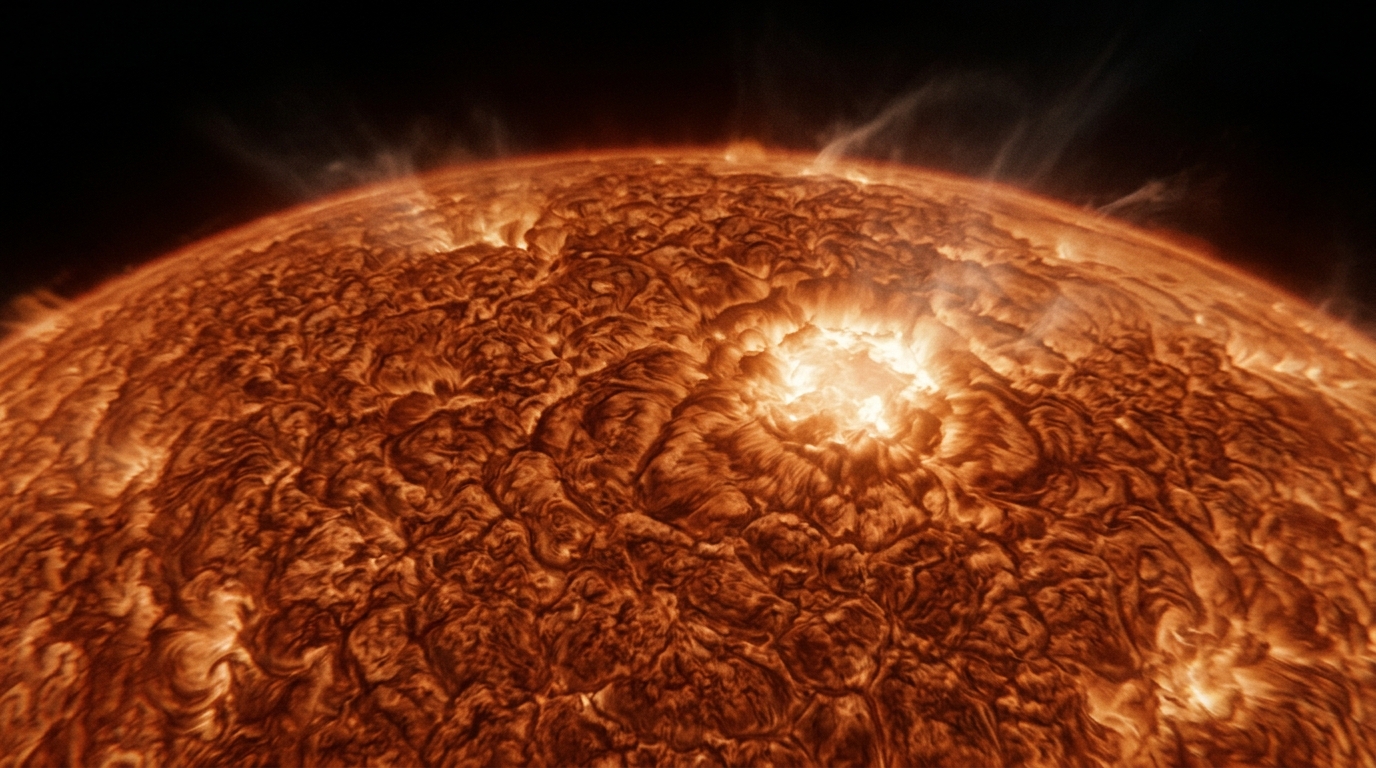
The Bubbling Surface of a Doomed Star
Related Episode
Betelgeuse, Up Close: A Star's Boiling Skin, RevealedThe most detailed picture yet of Betelgeuse’s surface reveals a stubborn hot spot that may be stirred by a hidden companion, plus a spacewalk’s happy ending, a solar flare with a CME due Friday, a new SpaceX reuse record, and a near-total lunar eclipse this week: S05E177
The Bubbling Surface of a Doomed Star
Today’s episode covers the most detailed picture yet of one of the sky’s most famous — and most doomed — stars, a spacewalk that finally stuck the landing after an earlier close call, a serious punch from the Sun, a quiet reusability milestone, and an eclipse most of our listeners won’t get to see. Here’s the rundown, with links to everything we referenced.
The bubbling surface of Betelgeuse, revealed like never before
Astronomers using the ALMA array in Chile, led by Bill Dent of the European Southern Observatory, have released the most detailed picture yet of the actual surface of Betelgeuse — the red supergiant marking Orion’s shoulder, roughly 600 light-years away. The images show a corrugated, irregular surface with bright convective hot spots, driven by huge cells of rising and falling plasma — essentially the same physics as a boiling pot, at a scale that swallows everything out past Jupiter’s orbit if you dropped the star into our solar system. Betelgeuse runs about 20 times the Sun’s mass, puffed out to roughly 800 times its diameter, with an atmospheric temperature around 3,680°F — and at least two hot spots measured nearly 1,000°F hotter than the surrounding plasma.
What genuinely surprised the team: one hot spot in the northeastern region has persisted for more than seven years, far longer than current convection models predict such structures should hold together. The hot spot’s orientation lines up with the expected position of Betelgeuse B — a faint companion star imaged for the first time this past July by a separate team led by Miguel Montargès (Observatoire de Paris), using the Very Large Telescope’s SPHERE instrument, an exoplanet-hunting tool repurposed to block out Betelgeuse’s glare. That companion turned out to be more massive than earlier theories predicted — two to three times the Sun’s mass rather than roughly Sun-sized — and its position raises the possibility it’s actively influencing the giant star’s surface, though that link isn’t confirmed.
Betelgeuse is one of the closest stars to us expected to eventually go supernova, on a timescale of roughly the next 100,000 years — imprecise by design, since nobody gets to schedule it. As Dent put it, the star’s eventual fate as a supernova is exactly what makes it worth knowing what it actually looks like right now: a “before” baseline for whenever the real thing happens. It wouldn’t be the first time Betelgeuse has kept astronomers on their toes — the star’s dramatic, unexplained dimming in 2019-2020 briefly had people wondering if the end was near, before it turned out to be a self-ejected dust cloud rather than an early warning sign.
“You just saved the video dish”: ISS Spacewalk 98 finishes the job
NASA’s Anil Menon and ESA’s Sophie Adenot spent six and a half hours outside the International Space Station on August 25, finally completing a Space-to-Ground antenna replacement they’d started on August 18. The old antenna had stopped tracking NASA’s data relay satellites back in November 2025, with the station running on a backup since. This time the pair fully finished the swap — new antenna mounted on the Z-1 truss, faulty unit stowed permanently, power and data confirmed — earning a memorable line from Mission Control’s Anne McClain: “You just saved the video dish, you just saved the video dish.” It was Menon’s third career EVA and Adenot’s second; Adenot remains the first French woman ever to conduct a spacewalk, a record now backed by two completed outings rather than one interrupted one.
The Sun fires an M6.9 flare, with a CME due Friday
Sunspot region 4513 has been active for more than a day, producing five M-class flares including an M6.9 — just shy of the most powerful X-class category — that peaked the morning of August 25 and triggered radio blackouts across parts of Africa, Europe, and the Arctic. A slow-moving coronal mass ejection from the same event is forecast to reach Earth in a glancing blow around 6-7 a.m. US Eastern this Friday, August 28, with a separate high-speed solar wind stream arriving from the 27th. If the two overlap, forecasters expect unsettled to active geomagnetic conditions with a chance of minor storming — mostly a story for high Northern Hemisphere latitudes; we wouldn’t set an alarm for aurora this far south, though it costs nothing to check the horizon if you’re somewhere dark on Thursday or Friday night.
SpaceX quietly sets a reuse record
SpaceX’s hundredth Falcon 9 launch of 2026 — a Starlink mission lifting off Cape Canaveral at 5:33 a.m. Eastern on August 25 — carried booster B1067 on its 37th flight, a new record for a single first stage. Six different Falcon 9 boosters now have 30 or more flights each. For scale, Falcon 9 alone flew 165 successful missions in 2025, more than every other orbital rocket family on the planet combined.
Tonight’s Sky: a near-total lunar eclipse, two nights away (not for us)
The night of August 27-28 brings a partial lunar eclipse covering 96% of the Moon’s disc — about as close to total as a partial eclipse gets — with peak coverage around 12:12 a.m. US Eastern (4:12 UTC) on the 28th. It’s a good show across the Americas and, low near the horizon, parts of Europe and Africa, but Australia and the rest of Asia-Pacific will be on the daylight side of the planet when it happens (around 2:12 p.m. AEST in Sydney). Closer to home, Venus remains bright and easy in the western sky after sunset, and Saturn is well placed rising in the east after dark.
Links & sources
Space.com — The bubbling surface of doomed supergiant star Betelgeuse has been revealed like never before
Space.com — Betelgeuse, Betelgeuse! Astronomers capture clearest image yet of famous star’s elusive companion
Space.com — “You just saved the video dish”: Two astronauts complete spacewalk to replace ISS antenna
NASA — NASA, ESA Spacewalkers Finish Installing High-Speed Antenna
Space.com — Sun fires powerful M6.9 solar flare and CME toward Earth — could it boost northern lights chances this week?
Space.com — SpaceX sets rocket-reuse record on 100th Falcon 9 launch of the year
Space.com — What to expect from each stage of the partial lunar eclipse on Aug. 27-28
Space.com — Partial lunar eclipse August 2026 — Where will it be visible from?