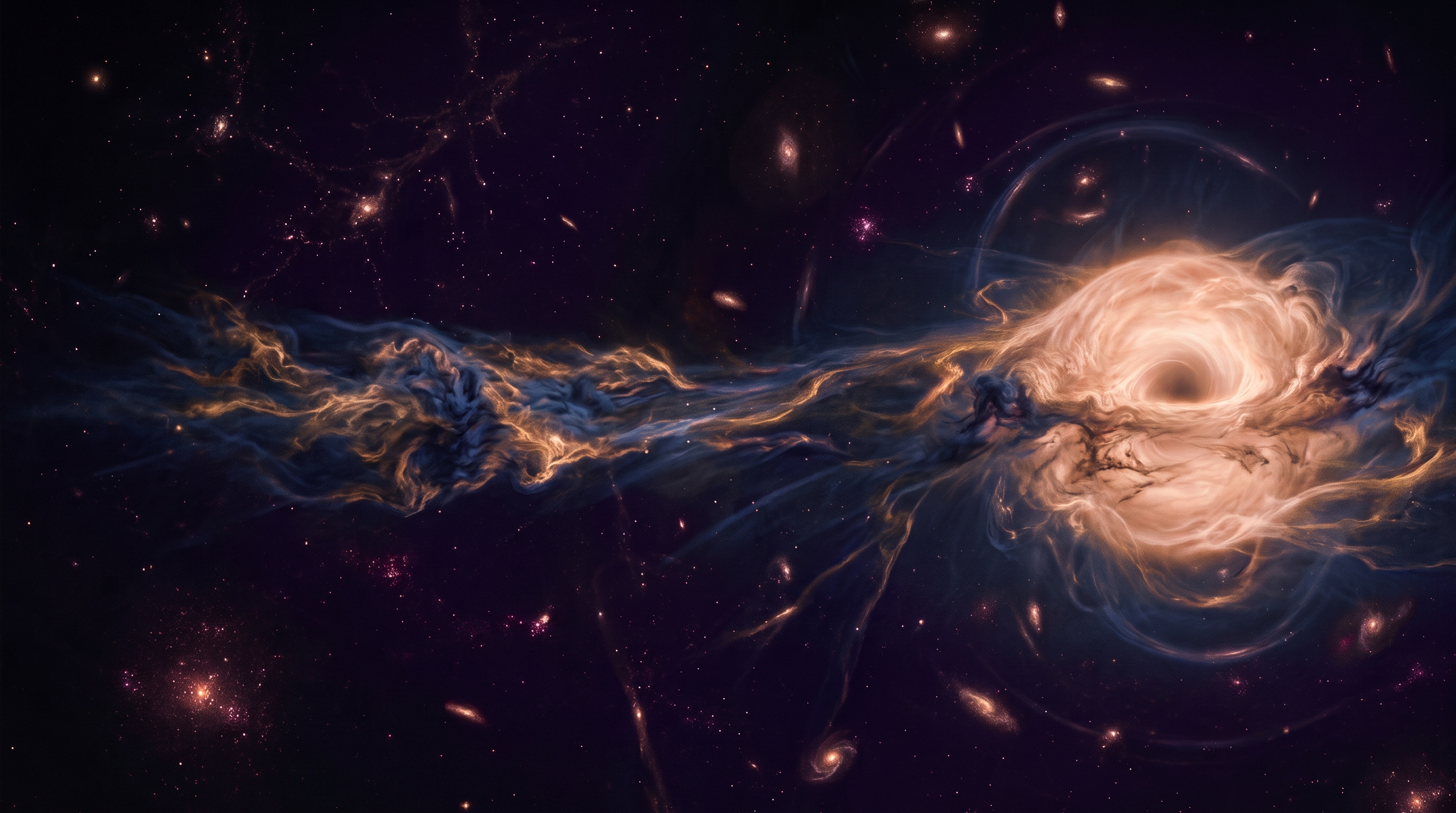
The Black Hole Wrapped in a Star: JWST's Cosmic Dawn Discovery
Today on Astronomy Daily: a gas-shrouded black hole from 13 billion years ago, a spectacular Perseid peak, a satellite built to watch other satellites, and a veteran astronaut’s well-earned retirement”
episode: “S05E167”
date: 2026-08-14
A day after telling you about three supermassive black holes sharing a single galaxy, Anna and Avery are back with what might be the missing piece in how those black holes got so big in the first place: a strange hybrid object the James Webb Space Telescope has spotted glowing from just 660 million years after the Big Bang. Then: a spectacular Perseid meteor shower peak right on the heels of this week’s total solar eclipse, a new satellite designed to keep watch over geostationary orbit, and NASA astronaut Mike Fincke’s retirement after thirty years and four different spacecraft. Here’s the rundown, with links to everything we referenced.
A black hole wearing a gas trench coat
Meet MoM-BH*-1 — the earliest confirmed example of a strange class of object astronomers are calling a “black hole star.” It isn’t a star in the traditional sense. It’s a young, rapidly growing black hole wrapped in an extremely dense, turbulent envelope of gas so thick that the whole object radiates almost like a star, even though a black hole is doing the work at the center. That gas envelope also makes the object look enormous — its light-emitting region spans more than 100,000 times the radius of the Sun — even though the black hole and its accretion disk underneath are comparatively tiny.
The discovery comes from the “Mirage or Miracle” JWST survey, led by Rohan Naidu at the University of Hawai’i’s Institute for Astronomy and Jorryt Matthee at the Institute of Science and Technology Austria. The team identified MoM-BH*-1 through a strong Balmer break in its spectrum — a signature normally associated with stars — appearing alongside clear evidence of a supermassive black hole. Light from the object left it roughly 13 billion years ago, just 660 million years after the Big Bang, making it the earliest black hole star confirmed to date.
The finding speaks to a genuinely old puzzle: astronomers have found supermassive black holes, billions of times the Sun’s mass, in galaxies far too young to have grown them through ordinary gas accretion alone. A black hole star like MoM-BH*-1 may represent that missing fast-growth phase — a black hole caught mid-binge, feeding at an accelerated rate inside its own gas cocoon.
There’s a bigger connection here too. Since 2024, JWST has turned up hundreds of mysterious compact objects nicknamed “little red dots” — common in the early universe, essentially absent today, and hard to explain. The leading theory now is that little red dots and black hole stars are the same phenomenon: black holes shrouded in hot, ionized gas that glows star-like while they grow, fading from view once the envelope is consumed. If that holds up, MoM-BH*-1 could be the clearest example yet of the engine behind the little red dot population.
It’s not a settled question. The “Mirage” in the survey’s name is a nod to real scientific debate — the interpretation rests on a subtle spectral reading, and the result circulated as a preprint for more than a year before this. Matthee, for his part, is leaning toward “miracle”: “Far from a mirage, this might well be a cosmic miracle.” Naidu’s working theory for how these objects form involves collisions and mergers of supermassive stars inside dense early-universe star clusters — a model that might also explain unusual chemistry seen in old globular clusters much closer to home.
Two nights, two spectacles: the Perseids peak right after the eclipse
If Tuesday’s eclipse wasn’t enough sky-watching for one week, the Perseid meteor shower peaked overnight between August 12th and 13th — mere hours after the Moon finished crossing the Arctic-to-Mediterranean path we covered last episode. Conditions were close to ideal: the peak fell near the August new moon, so dark skies let observers in good locations see hundreds of meteors an hour with the naked eye.
Perseid meteors are debris from comet 109P/Swift-Tuttle, mostly dust- and sand-sized particles hitting Earth’s atmosphere at around 37 miles per second. Astrophotographers from Iran, Israel, Texas, Spain, Turkey and China captured the peak, often framing meteor streaks alongside the Milky Way, the Andromeda galaxy and the Pleiades in the same shot. Swift-Tuttle’s debris trail stays active through roughly August 24th, so there’s still a window — smaller each night — to catch a few more before it tails off.
Astranis unveils Perceptor, a satellite built to watch other satellites
San Francisco-based Astranis announced a new spacecraft line called Perceptor, designed to monitor activity in geostationary orbit — the roughly 22,236-mile-high band where much of the world’s communications, military and early-warning satellite infrastructure sits. Built on Astranis’s smaller “MicroGEO” platform and equipped with electric propulsion, Perceptor is designed to reposition itself repeatedly over its mission and conduct multi-angle flybys of other spacecraft, both to help troubleshoot friendly satellites and to keep closer tabs on what other nations’ spacecraft are doing nearby.
The announcement leans heavily on the security angle. Astranis CEO John Gedmark said plainly: “There are blind spots that will be used against us if not eliminated,” citing a 2020 incident in which a Russian spacecraft approached within about 100 miles of a U.S. spy satellite, and 2023 reports of Chinese reconnaissance activity near suspected U.S. Space Force satellites. Astranis already operates five satellites in GEO supporting military, connectivity and GPS-related missions; no launch date for Perceptor has been announced yet.
Veteran astronaut Mike Fincke retires after 30 years and four spacecraft
NASA astronaut Mike Fincke has retired after exactly thirty years with the agency, capping a career that spans nearly the entire modern era of human spaceflight. Selected in 1996 as part of the astronaut class nicknamed “the Sardines,” the retired Air Force colonel became one of only thirteen people to launch to orbit aboard three different spacecraft types — flying four missions in total across Soyuz (twice), Space Shuttle Endeavour, and SpaceX’s Crew Dragon Endeavour. He commanded the International Space Station twice, during Expedition 18 in 2008–09 and Expedition 74 this past December and January, and served as chief of the Astronaut Office’s Commercial Crew Branch while helping develop the Starliner program.
His final mission, Crew-11, launched in August 2025 alongside Zena Cardman, JAXA’s Kimiya Yui and Roscosmos cosmonaut Oleg Platonov — and ended early after a frightening medical incident in January, when Fincke lost the ability to speak for about twenty minutes during dinner aboard the station, an episode he described as coming on “completely out of the blue.” NASA brought him home as a precaution. In his farewell statement, Fincke said, “After exactly thirty years, I am departing NASA, but I remain deeply committed” to preparing the next generation of explorers.
Listen to the full episode
Anna and Avery cover all four stories in full on today’s episode of Astronomy Daily — S05E167, out now. [Listen here] and find full show notes, timestamps and sources on the episode page.
Sources: EurekAlert — “Mirage or miracle? JWST finds earliest known ‘black hole star’ at cosmic dawn” · phys.org — Mirage or miracle? JWST finds earliest known black hole star · Scientific American — JWST images illuminate “black hole stars” at cosmic dawn · ERC — Earliest known black hole star found at cosmic dawn · Space.com — Perseid meteor shower peak photos · Space.com — Astranis Perceptor satellites · [Spaceflight Now — Mike Fincke retires from NASA](https://spaceflightnow.com/2026/08/12/mike-fincke-a-30-year-astronaut-with-experience