Shadow Day
Related Episode
Eclipse 2026: Where, When & How to Watch (Both Hemispheres)The only total solar eclipse of 2026 falls today. Here’s where it goes, what you’ll see, and why scientists are chasing it.
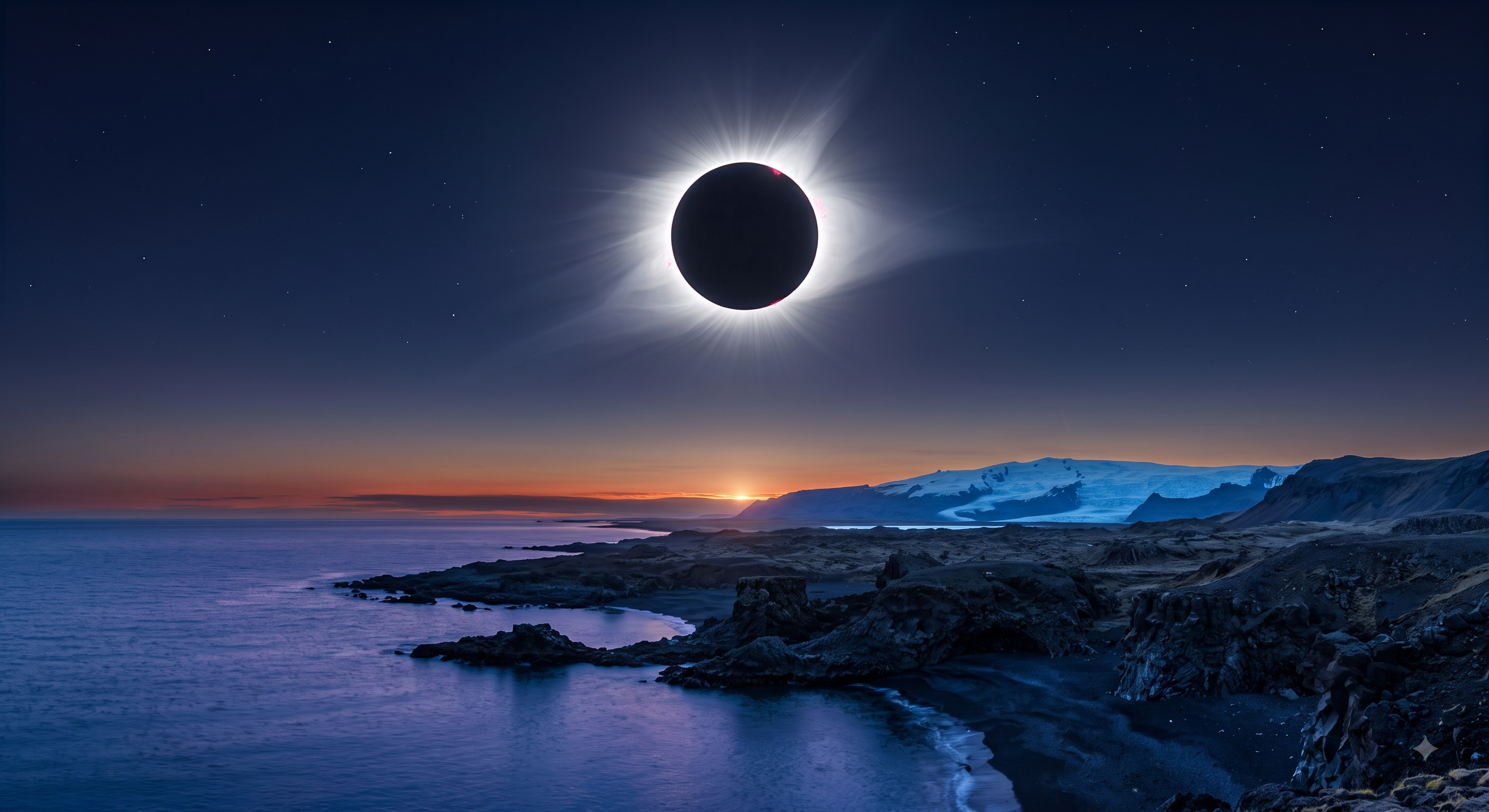
Every so often the Sun simply switches off. Not for long — a couple of minutes at most — but for those who happen to be standing in the right narrow strip of the world, a total solar eclipse is one of the most astonishing things the sky ever does. Today, 12 August 2026, is that day, and it’s the only total solar eclipse of the year.
This one takes an unusual route. Most eclipse tracks race roughly west to east; today’s arcs up and over the pole. It begins at sunrise over the Taymyr Peninsula in Arctic Russia, sweeps across the top of the world and down the eastern flank of Greenland, crosses western Iceland — Reykjavík included — then runs out across the North Atlantic before clipping a tiny corner of north-eastern Portugal and crossing northern Spain, from Galicia to the Mediterranean, finishing near the Balearic Islands right at sunset.
For Europe, that last stretch is the headline. This is the first total solar eclipse over western mainland Europe since 11 August 1999 — twenty-seven years, almost to the day. For Spain it’s the first since 1905; for Iceland, the first since 1954. Little wonder eclipse chasers have had these dates circled for years.
What you get, if you’re inside the path, is brief but unforgettable: up to about two minutes and eighteen seconds of totality near the centre line, shorter on land. In Reykjavík the Sun goes dark around 17:48 Universal Time — just before six in the evening, local — for a little over a minute. In northern Spain totality falls around 18:27 to 18:33 UT, which is 8:27 to 8:33 in the evening there. The catch in Spain is the low Sun: only about ten degrees above the horizon on the north coast, and as little as four near the Balearic Sea. Spectacular with a clean sightline; hidden entirely behind the wrong hill.
Most of us, of course, are nowhere near that strip — and here the news splits by hemisphere. In North America there’s a genuine partial eclipse this afternoon, deepest in the north-east: around a third of the Sun covered in Nova Scotia, close to 28 per cent in northern Maine, roughly 16 in Boston (near 1:55 pm Eastern), and about nine or ten in New York. Alaska gets a fine morning partial, with Fairbanks near 37 per cent. Crucially, none of this is totality — the Sun is never fully covered — so eclipse glasses stay on from the first bite to the last. Across the rest of Europe it’s a deep evening partial, with London near 91 per cent.
And for those of us in Australia and the wider Southern Hemisphere? Nothing in the sky at all — this is a Northern-Hemisphere event through and through. But you can still watch it happen. NASA, timeanddate and the Exploratorium are all streaming live from the path, telescope feeds and all. In Australian eastern time that coverage runs roughly half past one to six in the morning on Thursday, with the totality highlights around three to half past four a.m. Set an alarm; it’s worth it.
The reason people travel across the planet for those two minutes is the corona — the Sun’s faint, pearly outer atmosphere, revealed only when the Moon blots out the blinding disc. It’s beautiful, and it’s scientifically precious, which is why NASA will chase today’s shadow in a WB-57 jet at fifty thousand feet, stretching its view of totality to nearly three minutes and turning four cameras on the corona to study how it’s heated to a million degrees. A fleet of student-launched balloons over Iceland and Spain will measure what happens to the air itself as day briefly turns to dusk.
It’s a fitting day for it. The same new Moon that steps in front of the Sun also leaves tonight’s Perseid meteor shower — peaking in the small hours of the 13th — completely moonless, and that means the best shooting-star conditions in years. Northern-Hemisphere skies are favoured, but wherever you are, the recipe is the same: a dark spot, a bit of patience, and no equipment at all.
Whatever you catch — a partial through safe glasses, a corona on a screen at 3 a.m., or a streak of Perseid light after midnight — mind your eyes, and enjoy the day the sky blinks. Clear skies.