Roman Launches: A Telescope's Countdown Ends
Related Episode
Roman Launches: A Telescope's Countdown EndsIn this episode, of the Astronomy Daily Podcast: the Nancy Grace Roman Space Telescope flies clean on a Falcon Heavy, Elon Musk signals the eventual retirement of Falcon 9, two Nobel laureates defend an accelerating universe, and a single ancient asteroid strike solves two mysteries on Mars’s moon Deimos. Episode: S05E181
Roman Launches: A Telescope’s Countdown Ends
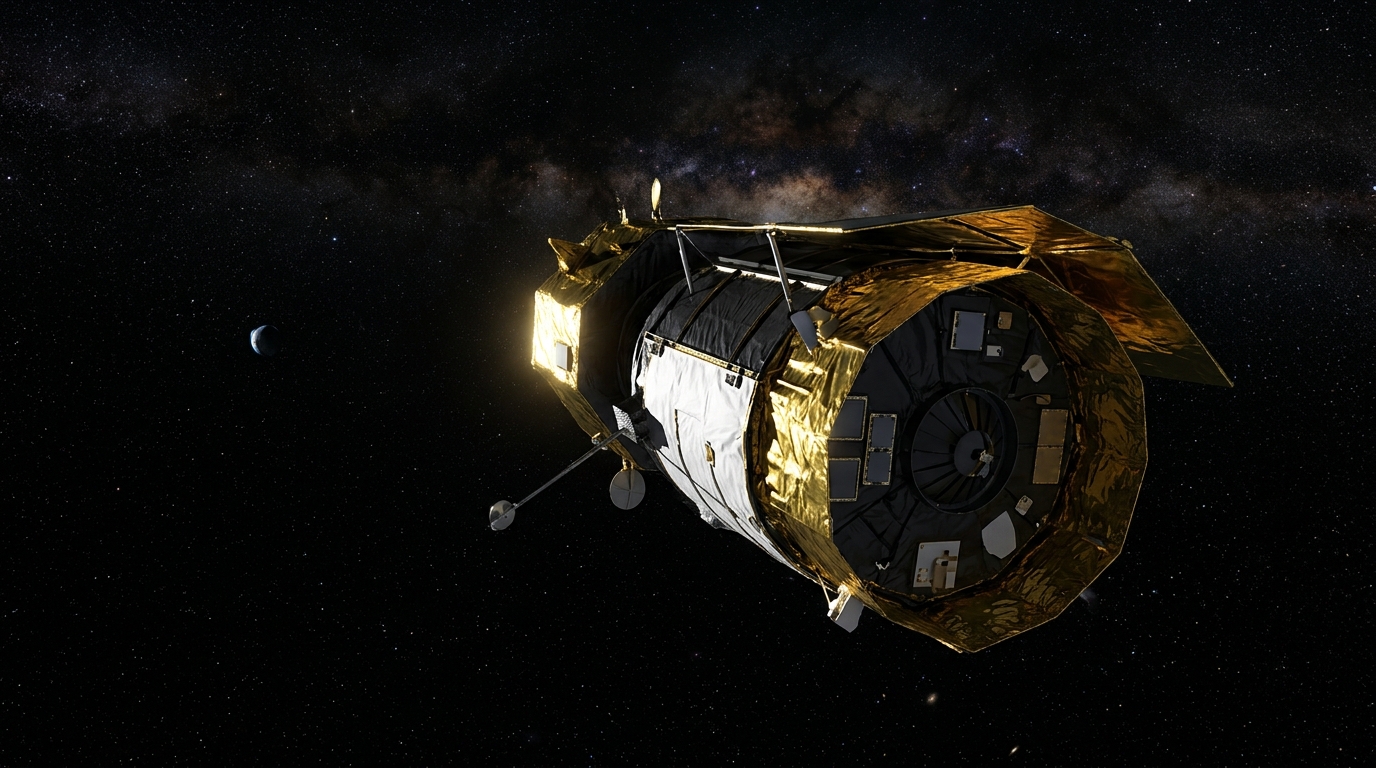
After a full week of build-up, the Nancy Grace Roman Space Telescope actually flew. Liftoff came Sunday, August 30 at 7:26am Eastern — right on the primary window, no scrubs, no holds — on a SpaceX Falcon Heavy from Kennedy Space Center’s storied Launch Complex 39A. The side boosters flew themselves home to Cape Canaveral in a textbook boostback, and Roman separated cleanly from the upper stage thirty-one minutes after liftoff, with no anomalies reported. It was, by NASA’s own account, about as tidy a launch as anyone could have asked for — and President Trump even called in live during the post-launch press conference to congratulate the team.
Roman is now on a ninety-day cruise to the Sun-Earth L2 point, the same neighbourhood James Webb calls home. Instrument activation runs the first forty days, science commissioning begins around day forty-five, and first images are expected in early 2027. There’s a genuine local thread here too: part of Roman’s science data will come down through a brand new ESA antenna at New Norcia, Western Australia, since Roman is a formal ESA partnership from the ground up.
The scale of the science ahead is the whole point of the mission. Roman shares Hubble’s 2.4-metre primary mirror, but its Wide Field Instrument delivers a view roughly a hundred times wider at essentially the same sharpness — program scientist Dominic Benford has described the smallest Roman images as a billion pixels each, more than any screen on Earth could display at once. The flagship High Latitude Wide Area Survey will image around two billion galaxies to map dark matter and chart the universe’s accelerating expansion, backed by a companion supernova survey. A separate microlensing survey will hunt exoplanets — including wide-orbit and free-floating rogue planets transit surveys can’t see — with on the order of a hundred thousand new detections expected, and a Coronagraph Instrument will demonstrate directly imaging exoplanets rather than just inferring them.
Sunday’s launch closes out a four-part story we’ve told across the week: Roman’s clearance for launch nine months ahead of schedule, the strange tale of its core optics beginning life inside a cancelled spy-satellite program before being donated to NASA in 2012, its narrow escape from a budget draft that would have cancelled it outright, and Saturday’s launch-eve preview. After everything that had to go right just to get it off the ground, it’s a satisfying thread to finally close.
Falcon 9’s eventual retirement
In a smaller but notable item, Elon Musk posted on X on August 22 that winding down both Falcon 9 and Falcon Heavy is “inevitable” once Starship is flying reliably several times a week. It’s a statement of intent rather than a timeline: Falcon 9 only just passed its hundredth launch of the year on August 25, with booster B1067 setting a new single-booster reuse record at thirty-seven flights on that same mission. Industry estimates put most Falcon 9 flights winding down from around 2028, with NASA’s crew and cargo missions to the ISS expected to keep flying on the rocket through at least 2030.
The universe is still speeding up
A team led by Phil Wiseman at the University of Southampton, working with Nobel laureates Adam Riess and Brian Schmidt, has published a rebuttal in the Monthly Notices of the Royal Astronomical Society to a November 2025 claim from a South Korean team that the universe’s expansion might be slowing. The culprit: the earlier analysis had effectively treated the age of a distant galaxy as though it matched the age of the individual star that later exploded as a supernova inside it, without properly correcting for host-galaxy mass. Fix that, and the acceleration Riess and Schmidt shared a Nobel Prize for discovering is still there — a fitting result to land the same week Roman launched with its own dedicated supernova survey built to chase this exact question.
One impact, two mysteries: Deimos
Finally, a team led by Sabina Raducan and Martin Jutzi has used the first published data from ESA’s Hera mission’s flyby of Deimos, Mars’s smaller, more distant moon, to explain two of its long-standing quirks at once: an unexplained depression near its south pole, and an oddly smooth, dusty surface for a body its size. About a hundred supercomputer simulations later, published in Nature Astronomy, the answer is a single asteroid roughly 320 metres across, striking at a 45-degree angle — violent enough to redistribute debris across the whole moon, but not so violent it would have shattered a body that’s essentially a porous rubble pile. Hera’s main job is studying what NASA’s DART mission did to the asteroid Dimorphos; this flyby was almost a bonus stop along the way.
Tonight’s sky: Venus is a brilliant, brief evening target low in the west after sunset, closing in on a conjunction with Spica that peaks tomorrow. Saturn has graduated to an all-night target ahead of its October 4 opposition, rings tilted a photogenic 7.5 degrees. Jupiter’s back in the pre-dawn sky, and the Moon is a bright waning gibbous. Full viewing details in the episode.
Follow us: @AstroDailyPod