NASA Finds the Crater a SpaceX Rocket Left on the Moon
Related Episode
NASA Finds the Crater a SpaceX Rocket Left on the MoonInternational teamwork pinpoints exactly where a Falcon 9 stage struck the lunar surface, plus NASA’s Swift telescope rescue mission fails, dark matter may be bending a black hole’s jet, and Rocket Lab launches its ninth radar satellite for Japan. S05E173
NASA Finds the Crater a SpaceX Rocket Left on the Moon
Two weeks after a spent SpaceX Falcon 9 upper stage struck the Moon, NASA and an international team of partners have pinpointed the exact impact site and released the first close-up images — turning an uncontrolled piece of space debris into a genuinely useful science opportunity. Here’s that story in full, along with three more: the private rescue mission for NASA’s ailing Swift telescope has officially failed, astronomers may have caught dark matter bending a black hole’s jet, and Rocket Lab launched its ninth radar satellite for Japan’s iQPS — plus links to everything we referenced.
NASA finds the crater a SpaceX rocket left on the Moon
A spent SpaceX Falcon 9 upper stage struck the Moon’s surface on August 5, 2026, at coordinates 19.4759°N, 266.7138°E. Because the stage was uncontrolled hardware left over from an earlier launch, astronomers around the world had been tracking it and generating rough predictions of where and when it would come down — turning the impact into something of a race to document the aftermath.
South Korea’s Korea Pathfinder Lunar Orbiter, known as Danuri, got there first, using its LUTI camera to image the impact site within hours and confirming the predicted location to within about 0.6 miles. Danuri’s team passed those refined coordinates to NASA’s Lunar Reconnaissance Orbiter, whose Narrow-Angle Camera imaged the site on August 11 and 12 — the images NASA released this week with a full analysis.
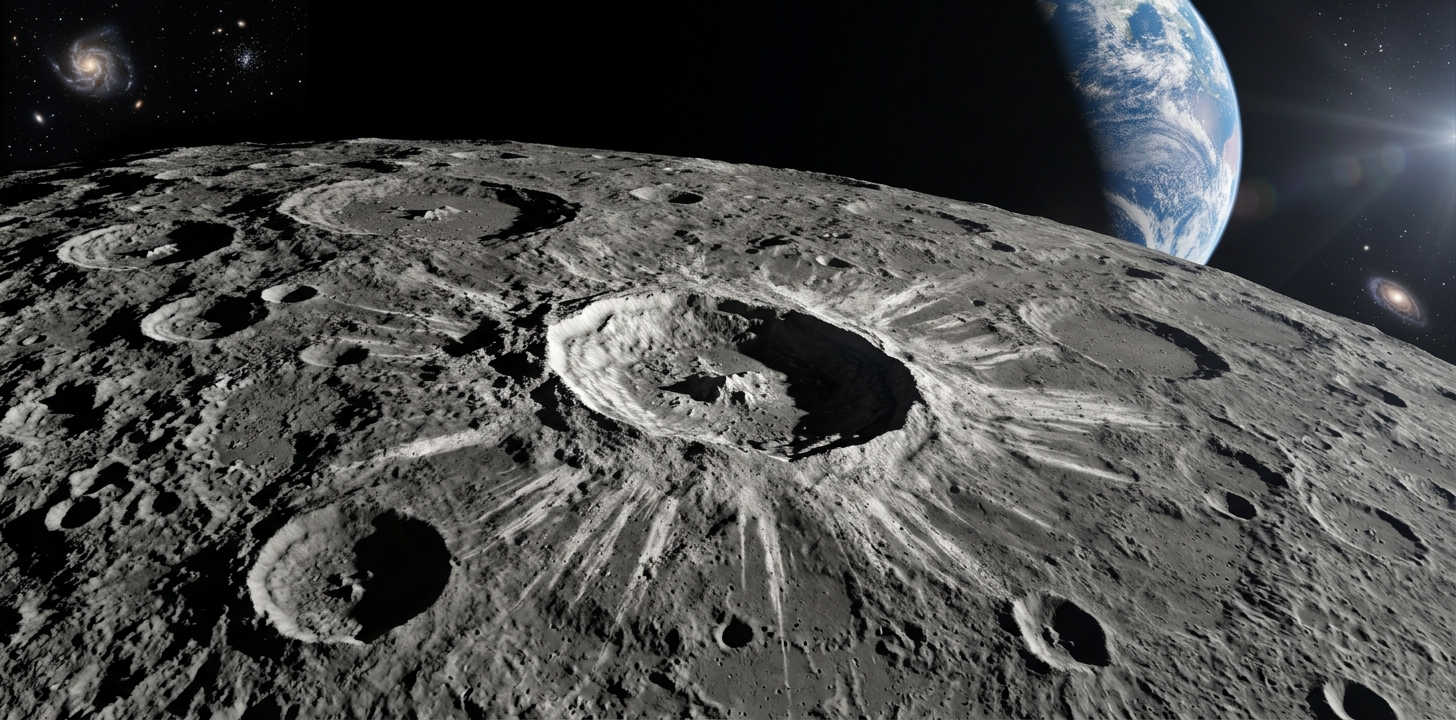
The resulting crater is modest by lunar standards: roughly 60 feet wide and less than 10 feet deep. What makes it scientifically useful is the pattern of ejected material, or rays, radiating outward from it. Darker rays consist of surface material that had already been “space weathered” by solar wind and cosmic rays, excavated from about 1.5 feet down; brighter rays are fresh, unweathered material dug up from deeper still. Together, the two give planetary scientists a precisely-dated cross-section of lunar soil at different depths — useful for calibrating how quickly the Moon’s surface weathers over time. NASA’s Center for Near Earth Object Studies, part of the agency’s Planetary Defense program, refined the original impact prediction using tracking data from independent astronomers.
Swift telescope rescue mission fails
NASA’s Swift Observatory — watching gamma-ray bursts and other high-energy events since 2004 — has been losing altitude faster than expected due to heightened solar activity increasing atmospheric drag. Facing an uncontrolled reentry before the end of 2026, NASA signed a $30 million contract with Arizona-based Katalyst Space Technologies to build a dedicated rescue spacecraft, LINK, and attempt to dock with and boost the telescope back to a safer orbit.
LINK launched July 3 on a Northrop Grumman Pegasus XL rocket, giving Katalyst under a year from contract to launch. About three weeks later, however, the spacecraft suffered an attitude-control failure and began spinning uncontrollably, unable to complete the planned rendezvous. NASA confirmed the mission’s failure on August 19; Swift is now expected to reenter the atmosphere uncontrolled sometime before the end of the year. LINK will still attempt a close proximity flyby, without docking, to gather data useful for future servicing missions. “This is not the outcome we were working toward, but it does not change why this mission was worth attempting,” said NASA Administrator Jared Isaacman.
Dark matter may be magnifying a black hole’s jet
A team led by Silke Britzen at the Max Planck Institute for Radio Astronomy has been studying PKS 2233-148, a blazar — a supermassive black hole launching a plasma jet nearly straight at Earth — using three instruments together: the Very Long Baseline Array for radio observations, the Fermi telescope for gamma rays, and, in one of its last contributions before its own demise, NASA’s Swift Observatory for X-rays.
Combining the three data sets revealed an unexpected deviation in the jet’s motion, consistent with gravitational lensing by an unseen clump of dark matter sitting between us and the jet — bending and magnifying its light much as a massive galaxy cluster lenses a background galaxy, just on a far smaller and harder-to-detect scale. If confirmed, it would be among the first detections of dark matter substructure lensing a blazar jet, offering a new tool for probing what dark matter actually is. There’s a bonus implication too: blazars are suspected sources of high-energy cosmic neutrinos, and a confirmed lensing event like this could help establish that connection. “We are very happy to have discovered as-yet-undetected phenomena in the jet, as well as in the gamma-ray light curve,” Britzen said. The result was published in Monthly Notices of the Royal Astronomical Society on July 31.
Rocket Lab launches a new radar satellite for Japan
Rocket Lab launched SUSANOO-II, a synthetic aperture radar Earth-observation satellite, for Tokyo-based iQPS on an Electron rocket from the company’s New Zealand launch site, on a mission nicknamed “The Lightning God Defends.” The satellite is Rocket Lab’s ninth launch for iQPS, part of a planned 36-satellite constellation designed to deliver near-real-time, high-resolution radar imagery — capable of seeing through cloud cover and working equally well day or night — to customers worldwide. SUSANOO-II deployed into low Earth orbit roughly 357 miles up about 50 minutes after liftoff, marking Rocket Lab’s 14th flight of 2026 and 93rd Electron mission overall.
Tonight’s sky
The Moon is a waxing gibbous tonight, about 63% illuminated. With a telescope four inches or larger, seek out the Ring Nebula, M57, in the constellation Lyra — look straight up after dark for the bright star Vega, then find the small parallelogram of stars just below it; M57 sits inside that shape, appearing as a small, pale grey smoke ring at 100–150x magnification, with an oxygen-III or narrowband filter helping it stand out further. Looking further ahead, mark your calendars for August 27–28: a partial lunar eclipse will cover 96% of the Moon’s face, about as close to total as a partial eclipse gets — full viewing details to come as the date approaches.
Links & sources:
- NASA Science — NASA’s LRO Images Falcon 9 Crater on Moon, Learns New Details
- Universe Today — NASA’s Lunar Reconnaissance Orbiter Images Falcon 9 Crater on Moon, With Some Help From a Korean Spacecraft
- Space.com — Private mission to save NASA’s Swift space telescope fails
- Live Science — ‘This is not the outcome we were working towards’: $30 million mission to save NASA’s Swift telescope fails
- Space.com — Dark matter could magnify the jets of a ravenously feeding supermassive black hole
- Space.com — Rocket Lab launches private Japanese Earth-observing satellite to orbit
- Space.com — Night sky August 2026: what you can see tonight
- TheSkyLive — Moon Phase on August 21, 2026
Follow us: search astrodailypod on your favorite platform · astronomydaily.io