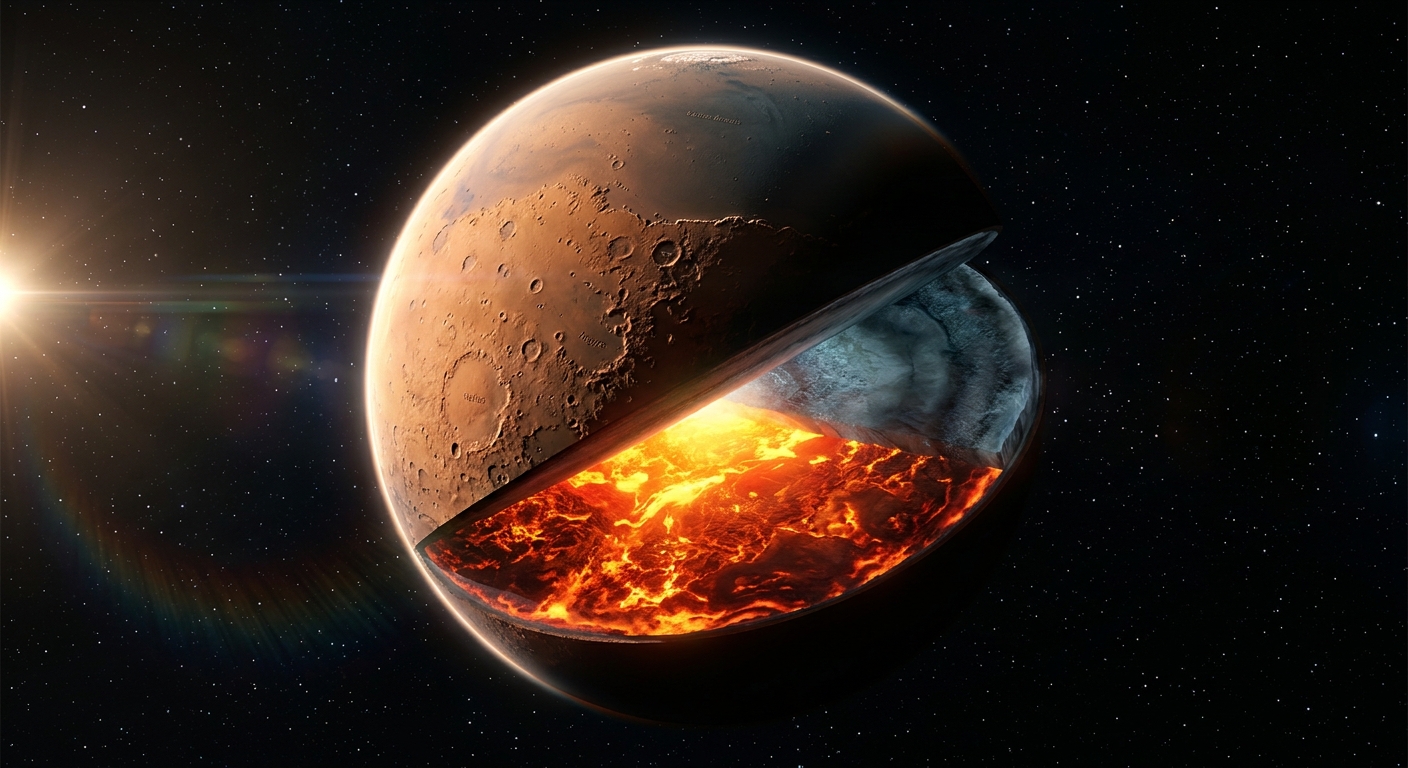
Mars Is Lopsided All the Way Down
Related Episode
There's Something Molten Under Mars's South PoleAstronomy Daily · S05E183 · Wednesday, September 2, 2026 · companion blog post
If you have ever seen one of those false-colour topographic maps of Mars — the ones where blue is low and red is high — you have seen the problem, whether or not anyone pointed it out to you. The northern third of the planet is smooth, low and comparatively young. The southern two-thirds is high, ancient and hammered with craters, sitting on crust that is markedly thicker. Between them runs a boundary that is, in places, a step of several kilometres.
Planetary scientists call it the crustal dichotomy, and it has been sitting in the literature, unexplained, since the Viking orbiters mapped it in the 1970s. It is not a subtle statistical feature. It is the single most obvious thing about Mars, and for fifty years nobody has been able to say why it is there.
A paper published in Nature on 27 August has just changed the shape of that question. A team led by Alexander Berne — who completed the work as a PhD student at Caltech and has since moved to the University of Arizona — reports that the dichotomy is not just a feature of the surface. It goes down. The interior of Mars’s southern hemisphere, they find, is somewhere between 200 and 400 degrees Celsius hotter than the interior of the north, and parts of it are partially molten.
How do you take the temperature of another planet’s interior?
This is the part of the story that deserves the attention, because it is genuinely elegant. There is exactly one seismometer that has ever operated on the Martian surface — InSight’s, which fell silent in 2022 — and seismology is the usual way you probe a planet’s insides. Berne’s team did not use it. They used the fact that Mars bends.
The Sun pulls on Mars the way the Moon pulls on Earth’s oceans. Mars has no oceans, but the entire solid body of the planet still stretches and relaxes very slightly over the course of its orbit. Crucially, how much it stretches depends on what its interior is made of and how hot that interior is. Hot, soft, partly molten rock deforms more readily than cold, rigid rock. Measure the flex, and you have measured the temperature.
The flex is tiny. But a planet that changes shape is also a planet whose gravitational field changes shape, and we have had spacecraft in orbit around Mars, being tracked continuously by radio from Earth, for decades. As each orbiter passes over a region, its velocity is nudged by the gravity beneath it. Those nudges are measurable to extraordinary precision.
So the team went into the archive. They pulled radio tracking data from Mars Global Surveyor, Mars Odyssey and Mars Reconnaissance Orbiter — roughly twenty-five years of it — and reconstructed how the Martian gravity field breathes across a Martian year. Enough measurements, from enough angles, and you can invert the whole thing into a picture of the interior. Hence tidal tomography: the same word as a medical CT scan, doing much the same job.
It is worth pausing on the fact that Mars Global Surveyor launched in 1996 and stopped transmitting in 2006, and its data is still producing front-line results twenty years later. Almost none of the value now being extracted was anticipated when those missions were designed. It is a quiet argument for archiving everything, indefinitely.
Three puzzles, one answer
What makes the result persuasive is not the dichotomy alone. It is that a hotter southern interior tidies up two other long-standing oddities at the same time.
The first is magnetism. Mars has no global magnetic field today, but its crust is magnetised in patches — a frozen record of a dynamo that shut down billions of years ago. Those magnetic anomalies are overwhelmingly concentrated in the southern highlands, which has always been peculiar. A hemisphere with a fundamentally different thermal history would acquire and retain that record differently.
The second is seismic. While InSight was operating, it found that seismic waves passing through parts of the Martian interior were being damped far more strongly than models predicted. Waves lose energy quickly in hot, soft material. Partially molten rock in the southern mantle is precisely what would produce that signature.
Three independent observations, previously filed separately, now pointing at one underlying fact. That is usually what a real result looks like.
What it does not explain
The team is careful about this, and so should we be: knowing that the southern interior is hotter does not tell you why. Three broad explanations are on the table, and this paper does not choose between them.
A giant impact early in Martian history is the most dramatic option — something enormous striking the northern hemisphere, excavating the lowlands and reorganising the interior in the process. Lopsided mantle convection is the least dramatic: convection patterns in a planetary interior can settle into asymmetric configurations and simply stay there for billions of years. The third possibility is compositional — a layer down there enriched in radioactive elements, generating and trapping its own heat.
What the paper does supply is a number. Any model that wants to explain the dichotomy now has to reproduce a 200-to-400-degree hemispheric temperature difference. That is a much harder test than “make the north lower than the south,” and it moves the question from surface geology into the physics of the whole planet.
And the water
There is one more thread here, and it is the one that will matter most to people who care about Mars as a place rather than as an object. The northern lowlands are exactly where you would put an ancient Martian ocean, if Mars ever had one. They are the basins. Whatever made the north low also decided where any standing water on early Mars would have gone.
As the Caltech team put it, understanding the dichotomy matters because it tells you about the processes that shaped the hydrology of Mars — including the formation of the basins that may have held water. The heat under the south pole and the question of whether Mars was ever wet turn out to be the same question, approached from opposite ends.
We are a show made in the Southern Hemisphere, and we spend a good deal of time explaining why the southern sky is the more interesting one. It is pleasing, in a small way, to be able to say the same about Mars — with the caveat that on Mars, the interesting part is several hundred kilometres below your feet.
Hear the full discussion, plus Crew-13’s stand-down, Swift’s last weeks of science and an 80,000-year mission to Alpha Centauri, in Astronomy Daily S05E183. Show notes and sources at astronomydaily.io.