Is Empty Space Really Empty? A 90-Year-Old Mystery Gets Its Answer
The Weekend Wrap: a magnetar confirms a 1936 prediction about the vacuum, plus a round-up of the week’s biggest stories — Starship’s fate at sea, the August 12 eclipse, JWST’s black hole star, and Virgin Galactic’s rough week”
episode: “S05E168”
date: 2026-08-15
Is Empty Space Really Empty? A 90-Year-Old Mystery Gets Its Answer
Welcome to the Weekend Wrap — Astronomy Daily’s weekend round-up of the week’s biggest news for anyone who needs to catch up. This week that round-up has a lot to cover, so here’s the rundown, with links to everything we referenced.
A magnetic star may have solved a 90-year-old mystery about “empty” space
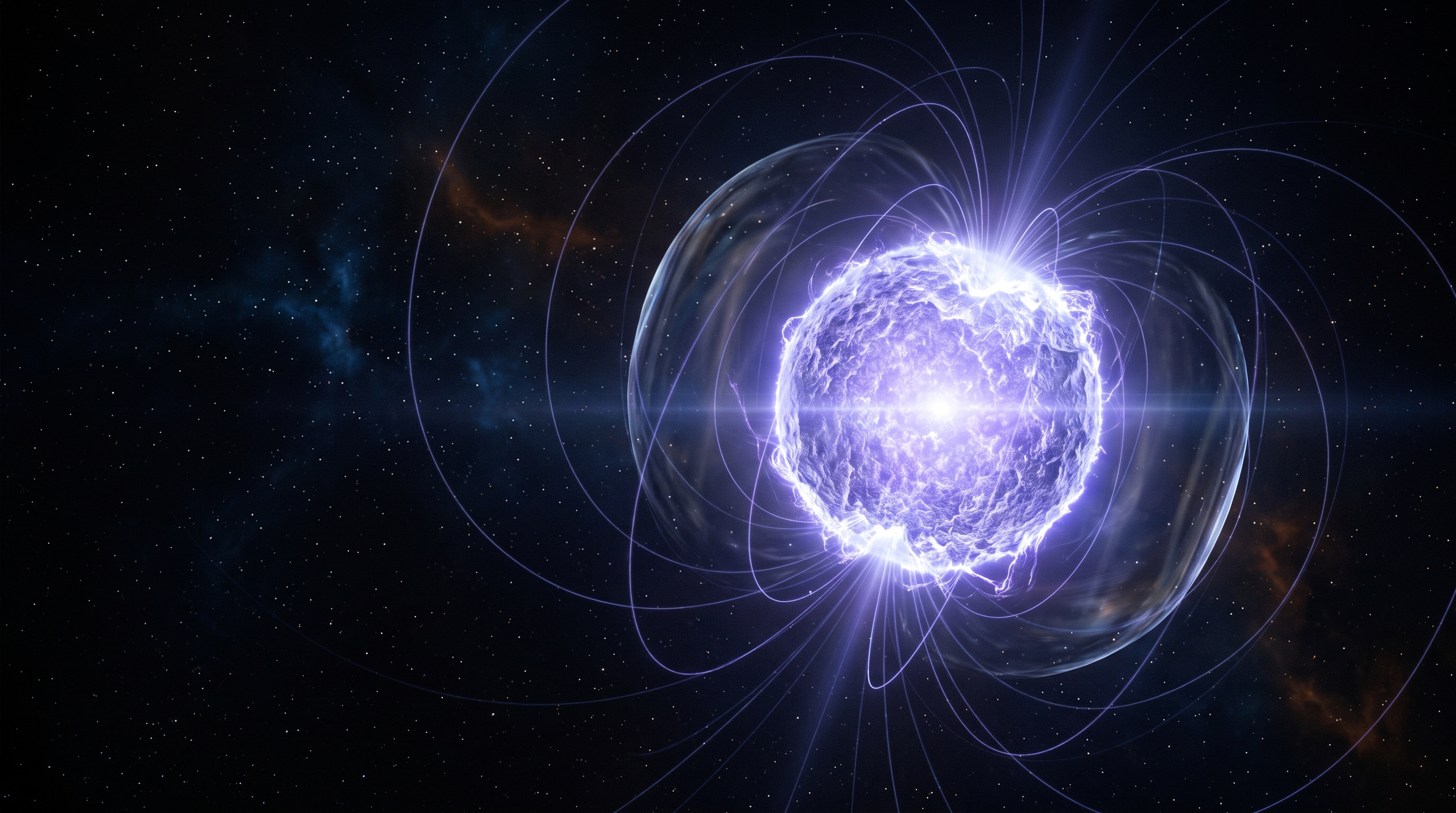
In 1936, physicists Werner Heisenberg and Hans Euler proposed something strange: that a vacuum isn’t truly empty, but filled with a simmering sea of virtual particles flickering in and out of existence. One consequence of that idea, if true, is vacuum birefringence — an effect where an extraordinarily strong magnetic field should polarize light passing through empty space, the vacuum itself acting a little like a lens. The catch is that testing it requires a magnetic field over 100 million times stronger than anything ever produced on Earth, so the prediction sat unconfirmed for nine decades.
A team led by Rachael Stewart, a physics graduate student at George Washington University, has now found the strongest evidence yet that it’s real. Using NASA’s Imaging X-ray Polarimetry Explorer (IXPE), along with supporting observations from the International Space Station, Australia’s Murriyang radio telescope and the South African Radio Astronomy Observatory, the team — including Marcus Lower (Swinburne University), Michela Negro (Louisiana State University) and Fernando Camilo (SARAO) — studied a magnetar called 1E 1547-5408 in March and April of 2025.
They found X-rays nearly three times more polarized than standard neutron-star surface models could explain, with the polarization direction lining up with the star’s magnetic field and matching patterns already seen in its radio waves. Together, those two findings point to vacuum birefringence as the explanation. “We’re not just studying astronomical objects anymore; we’re using them to test the laws of nature,” Stewart said. Lower, describing the scale involved, noted that “detecting vacuum birefringence requires a magnetic field over 100 million times stronger than any we’ve ever made on Earth” — and added that the confirmation is “a bit of a relief because it means that our theories still work and there’s nothing broken with physics.” The research, published August 5 in Nature, is a strong first detection rather than a final word; a future mission called GoSOX is designed to chase the effect further.
The week in review
Starship: still adrift, still unresolved
Monday’s episode covered SpaceX’s Starship Flight 13 upper stage, Ship 40, which survived an unprecedented soft splashdown in the Indian Ocean off Western Australia on July 24 and was being towed toward shore — until deteriorating seas put the recovery in doubt. On August 7, Elon Musk said “ship recovery is not looking good right now.” As of this weekend, the outcome remains unresolved: Ship 40 is still reportedly afloat, prediction markets put the odds of a successful recovery at around 18%, and SpaceX has already secured the close-up heat shield and engine imagery that was the main objective regardless of outcome. Meanwhile the program has moved on — Ship 41 is in its own test sequence for Flight 14, targeted for around August 20.
The August 12 total solar eclipse
Thursday’s main story: a 182-mile-wide shadow swept from the Arctic Ocean across eastern Greenland and western Iceland to northern Spain and the Mediterranean. The longest totality on land — 2 minutes 18 seconds — fell at Látrabjarg, Iceland; millions gathered across northern Spain, with observers getting a rare direct view of the solar corona, a prominence, and Jupiter, Mercury and Venus during totality. Spain gets another total solar eclipse on August 2, 2027.
JWST’s “black hole star”
Friday’s main story: astronomers led by Rohan Naidu (University of Hawai’i) and Jorryt Matthee (ISTA) identified MoM-BH*-1, a black hole shrouded in dense gas so thick it glows almost like a star, spanning over 100,000 times the Sun’s radius. Light from the object left it roughly 13 billion years ago — 660 million years after the Big Bang — making it the earliest confirmed object of its kind, and a candidate explanation for how supermassive black holes grow fast enough to match observations of the early universe.
Virgin Galactic’s rough week
Thursday brought news that Virgin Galactic’s commercial comeback flight has slipped from Q4 2026 to February 2027, pending further avionics and systems work; shares fell about 12% after-hours. Wednesday’s Q2 2026 earnings compounded it — revenue of $1.54 million, a net loss near $55.9 million, and guidance for $95–100 million in cash burn in Q3 alone, sending shares down a further ~7.7% and prompting a shelf filing that gives the company flexibility to raise capital (with dilution risk). The one bright spot: $750,000 seat packages were oversubscribed, and the company plans “higher price points” when sales reopen this autumn.
Links & sources:
- Space.com — Is empty space really empty? This magnetic star may finally solve a 90-year-old mystery
- Space.com — ‘Not looking good right now’: Starship likely to be lost at sea 2 weeks after epic 13th test flight, Elon Musk says
- NASASpaceFlight.com — While SpaceX recovers Ship 40, Ship 41 prepares for testing ahead of Flight 14
- Manifold Markets — Will Starship Ship 40 be recovered to shore?
- Universe Magazine — SpaceX loses a Starship stage after two weeks in the ocean
- Space.com — Total solar eclipse 2026 thrills millions
- Wikipedia — Solar eclipse of August 12, 2026
- EurekAlert — Mirage or miracle? JWST finds earliest known ‘black hole star’ at cosmic dawn
- Scientific American — JWST images illuminate ‘black hole stars’ at cosmic dawn
- SpaceNews — Virgin Galactic delays resumption of commercial flights to 2027
- Virgin Galactic — Q2 2026 financial results and business update
- StocksToTrade — Virgin Galactic (SPCE) news, Aug 13 2026
Follow us: @AstronomyDailyPod