First Frenchwoman in Space Steps Outside
Related Episode
First Frenchwoman in Space Steps OutsideA historic spacewalk runs into antenna trouble, a trillion-mile river of gas explains tilted planets, an update on Starship’s Ship 40, and SpaceX quietly nears 11,000 satellites
“S05E171”
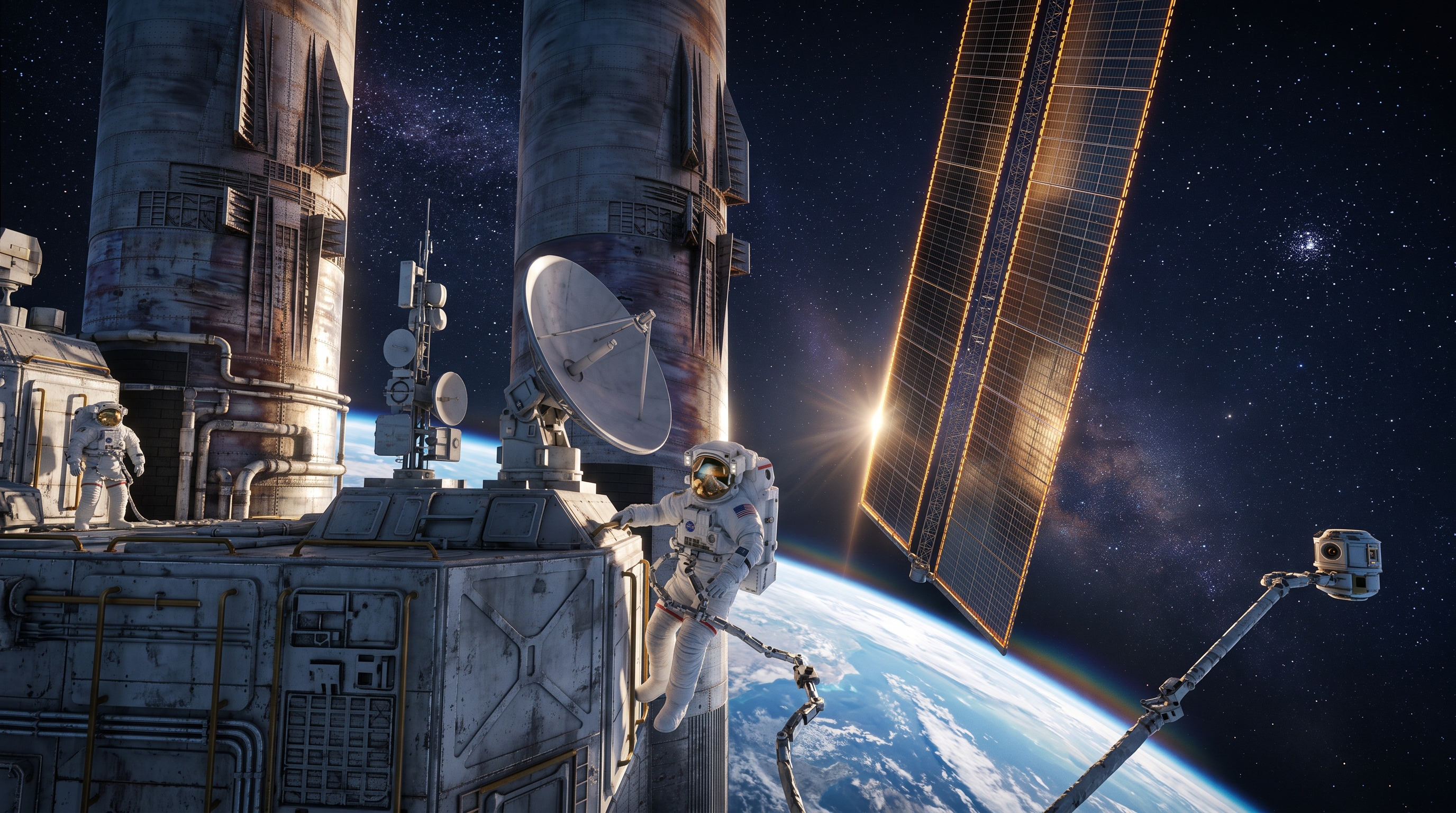
First Frenchwoman in Space Steps Outside Yesterday, ESA astronaut Sophie Adenot became the first French woman ever to conduct a spacewalk — a genuine spaceflight milestone that came with a real-world complication: the antenna swap she and NASA’s Anil Menon set out to complete didn’t quite get finished in time. Here’s that story in full, along with three more: a newly discovered trillion-mile river of gas that explains why some young planetary systems end up tilted instead of neatly ordered, an honest correction on where Starship’s Ship 40 actually ended up after we called its recovery “complete” last episode, and SpaceX’s quiet march toward 11,000 satellites in orbit — plus links to everything we referenced. First Frenchwoman to spacewalk ESA astronaut Sophie Adenot became the first French woman in history to conduct a spacewalk on August 18, working alongside NASA’s Anil Menon on his second EVA (delayed from August 13 after a carbon dioxide sensor flagged an anomaly during his first spacewalk on August 6, which later returned to normal). France’s first-ever spacewalk was performed by Jean-Loup Chrétien aboard Mir back in 1988 — it took nearly forty years for a Frenchwoman to get the same opportunity.
The pair set out to replace one of the International Space Station’s two space-to-ground antennas (SGANTs), a critical high-speed communications link between the station and Mission Control in Houston. The job proved tougher than expected: freeing the cables, working the locking pins and unbolting the failed antenna all took longer than planned, largely due to the sheer physical effort required in a pressurized suit. After 6 hours and 23 minutes — the station’s 282nd spacewalk overall — flight controllers called it before the swap could be completed. The failed antenna is secured near its mounting boom rather than fully stowed, and the replacement remains on its storage platform. Another spacewalk is scheduled for next Tuesday, with controllers still deciding whether to prioritize finishing the swap then. Because the station carries two SGANTs for redundancy and only needs one operational, there’s no immediate communications impact. A trillion-mile river of gas explains tilted planets Astronomers led by Maria Galloway-Sprietsma, a PhD student at the University of Florida, working with her advisor Jaehan Bae and international collaborators from the Max Planck Institute for Astronomy, University of Galway and Queen Mary University of London, have identified a likely mechanism for why some young planetary systems end up with misaligned or tilted orbits rather than neatly ordered ones. Using the ALMA telescope array in Chile, the team traced a stream of gas roughly 1.2 trillion miles (about 0.2 light-years, or 12,600 astronomical units) long feeding into GW Orionis, a young triple-star system 1,300 light-years away in the constellation Orion, already known for its unusually warped, multi-ring protoplanetary disk.
Because the molecular hydrogen that makes up most of the gas is invisible at radio wavelengths, the team traced the streamer using carbon monoxide as a stand-in tracer. When they modeled the streamer’s infall, its angle closely matched the tilt of the disk’s outermost ring — located roughly 31.6 billion miles from the system’s center, well beyond two inner rings at 4.1 and 17.4 billion miles. “If these streamers are common, then we can naturally explain why planets may not necessarily end up in very orderly systems,” said Bae. “They can have much, much more random orientations.” The findings were published August 6 in The Astronomical Journal; the team’s next step is a systematic survey of young stars to gauge how common these gas streamers actually are. Correction: Ship 40’s journey isn’t over after all Last episode, we reported that SpaceX had completed recovery of Starship’s Ship 40 after its intact splashdown in the Indian Ocean following Flight 13, based on reporting available at the time from NASASpaceFlight and MarineRadar. Fuller coverage that emerged later the same day tells a more complete story: rather than being recovered at a mainland Australian port, Ship 40 was towed much further and arrived, as of August 18, in sheltered waters off Christmas Island, the Australian territory in the eastern Indian Ocean — after 24 days and more than 400 kilometers adrift since its July 24 splashdown.
SpaceX engineers are now traveling to the site to conduct a closer inspection and stabilize the vehicle in calmer waters before the next leg of its journey: transport all the way back to Starbase, Texas, for full teardown and analysis. The exact transportation method for the 171-foot vehicle hasn’t been detailed yet. Elon Musk has described the intact recovery as providing valuable data that would otherwise have been lost, and said it strengthens the case for attempting a tower catch of a returning Starship as early as Flight 14. SpaceX quietly passes 11,000 satellites SpaceX’s Starlink 17-50 mission lifted off Tuesday night from Vandenberg Space Force Base in California, sending 24 more broadband satellites to orbit. The launch marked SpaceX’s 97th Falcon 9 flight of the year and its 100th mission overall for 2026, and pushed the Starlink constellation to nearly 11,000 operational satellites — a scale of megaconstellation that didn’t really exist as a concept a decade ago. Booster B1097 flew for the 12th time, having previously supported missions including Twilight, Transporter-17, Sentinel-6B and several earlier Starlink batches, and targeted a droneship landing in the Pacific roughly eight and a half minutes after liftoff. Tonight’s sky Before dawn tomorrow, Saturn puts on one of its best shows of the year: its rings are unusually narrow and shallowly tilted right now (about 7.5°), lining up its major moons in an almost straight row extending from the planet’s equator — a “moon parade.” Titan (magnitude +8.4) is easy to spot with a small telescope; a 4-to-6-inch scope brings in Rhea, Tethys and Dione, while an 8-to-10-inch instrument adds Iapetus and Enceladus. Saturn sits in the south-southeast sky in the hours before sunrise. This evening, look for a waxing crescent Moon.
Links & sources:
Space.com — Watch European astronaut make history during spacewalk today
Spaceflight Now — Astronauts remove failed antenna; run out of time to install a spare
France 24 — Sophie Adenot set to become first French female astronaut to venture outside ISS
Space.com — A ‘river’ of cosmic gas 1 trillion miles long sent planets in the Orion constellation into tilted orbits
University of Florida News — Cosmic river of gas may have tilted a young planetary system in Orion constellation
ALMA Observatory — ALMA Captures a Trillion-Mile Stream Feeding the Triple-Star System GW Orionis
NASASpaceFlight.com — Ship 40 arrives at Christmas Island, plans return to Starbase
Space.com — Starship lives! SpaceX craft arrives at Christmas Island after 24-day ocean ordeal
Space.com — SpaceX launches its 100th mission of the year, sends Starlink satellites to orbit
Spaceflight Now — Live coverage: SpaceX to send Starlink satellites to orbit with Tuesday night launch from California
Space.com — Night sky August 2026: what you can see tonight
Follow us: @AstroDailyPod