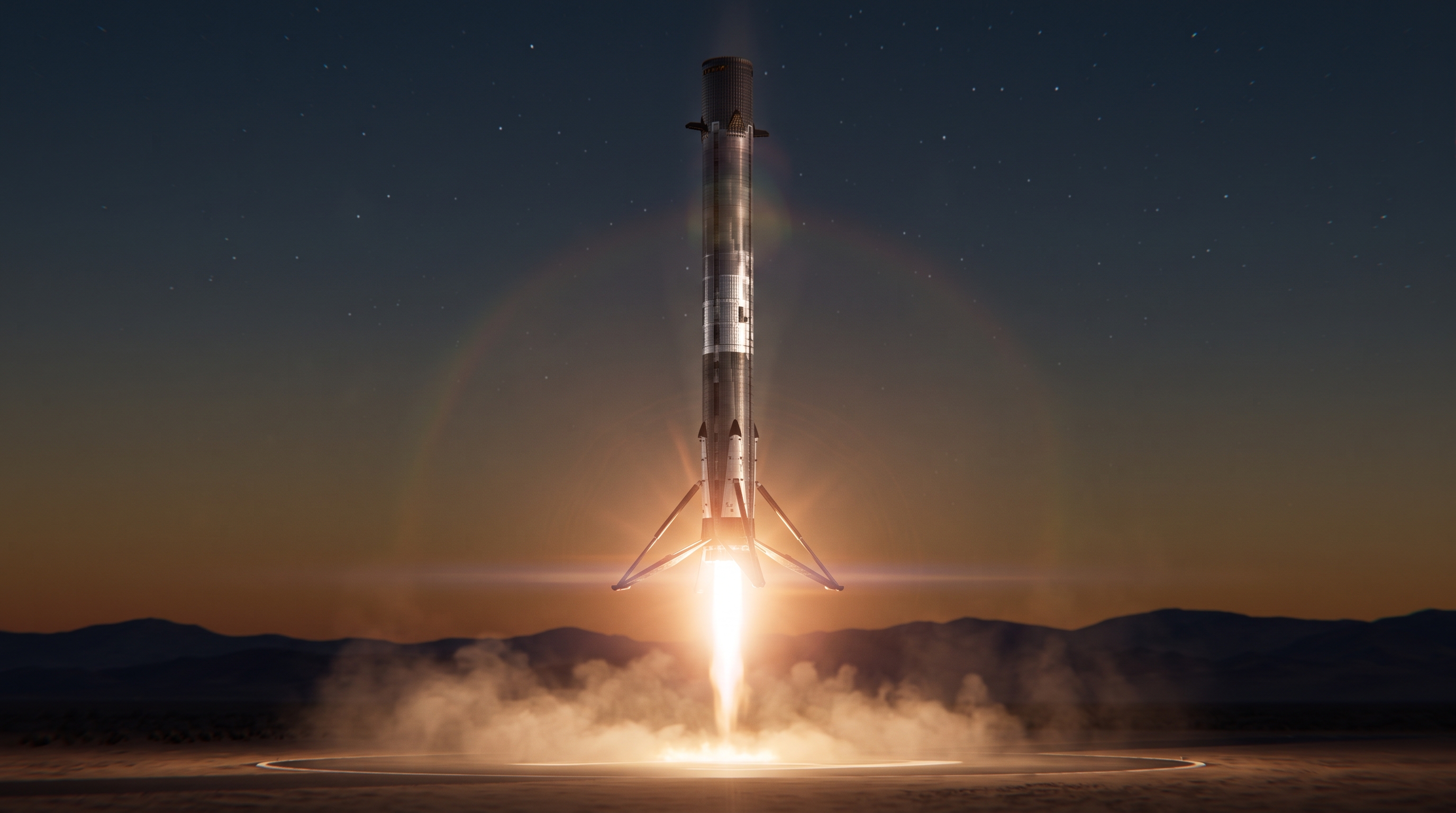
China's Private Rocket Sticks the Landing
Related Episode
LandSpace Nails It: China's First Private Booster RecoveryLandSpace becomes the first Chinese commercial company to land an orbital-class booster, plus a mega-Earth that defies planet formation models, a star that could reveal a black hole’s spin, and JWST finds the early universe was hiding its mass. S05E172
China’s Private Rocket Sticks the Landing
Yesterday, Chinese commercial launch company LandSpace became the first private Chinese company ever to land an orbital-class rocket booster — a genuine milestone for the country’s growing commercial space sector, and a story we’ve been watching build since an earlier attempt fell short last December. Here’s that story in full, along with three more: a “mega-Earth” that’s far too dense to fit current planet-formation models, a star weaving closer to our galaxy’s supermassive black hole than anything ever tracked before, and new James Webb Space Telescope data suggesting the early universe has been hiding roughly four times more mass than we thought — plus links to everything we referenced.
China’s private spaceflight sector sticks the landing
On August 19, LandSpace successfully recovered the first stage of its Zhuque-3 (ZQ-3) rocket after liftoff from the Dongfeng Commercial Space Innovation Pilot Zone in northwestern China — the first time any Chinese commercial company has landed an orbital-class booster. The 76.6-metre, stainless-steel, methane-fueled rocket — taller than a Falcon 9 — touched down on four legs roughly 390km downrange in Minqin County, Gansu Province, about eight minutes after liftoff, running on a single Tianque-12 engine and settling close to the center of the pad.
It’s ZQ-3’s second flight. The first, in December 2025, reached orbit successfully but couldn’t stick the recovery. This time it worked, putting LandSpace among a very small group of organizations worldwide with proven booster-reuse technology. The company describes the landing as marking a shift “toward the engineering application phase of reusability” — in other words, the point where the question stops being “can this work at all” and becomes “how do we make this routine.” Reusability is the technology that changed the economics of spaceflight for SpaceX, turning Falcon 9 into the world’s most frequently launched rocket; LandSpace’s landing is an early but real signal that China’s private sector is chasing the same advantage.
A “mega-Earth” that shouldn’t be this dense
Astronomers led by Max Kroft at the University of Wisconsin–Madison have identified GJ 523b, a rocky exoplanet 23.5 times more massive than Earth but only about 2.5 times its width — extraordinarily dense for its size. Standard planet-formation models say a planet this massive, orbiting its star every 17.75 days in a system just 170 million years old, should have pulled in a thick hydrogen-helium envelope and puffed up into something more like a mini-Neptune. Instead, it has stayed almost entirely rocky.
The planet was found using NASA’s TESS spacecraft and confirmed with follow-up observations from the WIYN 3.5-metre telescope at Kitt Peak National Observatory in Arizona. “This isn’t what we expected at all,” Kroft said. The result has been submitted to The Astronomical Journal and is available as a preprint, but hasn’t yet been peer-reviewed — an exciting first look rather than a settled result, and a genuine outlier that current planet-formation physics can’t fully explain yet.
The star that could reveal a black hole’s spin
A newly identified star, catalogued as S301, has been found orbiting Sagittarius A* — the supermassive black hole at the center of our own galaxy — closer and faster than any star tracked before it. S301 passes within 12 astronomical units of the black hole at closest approach, moving at roughly 25,000 kilometres per second, and completes a full orbit in just 8.7 years.
The discovery comes from a team led by K. Abd El Dayem at the Paris Observatory, working with Felix Mang and Stefan Gillessen at the Max Planck Institute, Juan Osorno at Paris-PSL, and a broader collaboration directed by Nobel laureate Reinhard Genzel. An orbit this tight and precise becomes a genuine physics instrument: general relativity predicts that a spinning massive object drags spacetime around with it, an effect known as Lense-Thirring precession, or frame dragging. We’ve measured tiny versions of this effect around Earth using satellites, but nobody has ever directly measured it around a supermassive black hole. The team believes that with continued observation of S301, they could measure Sagittarius A*’s spin directly within a decade — the first such measurement for any supermassive black hole, anywhere.
JWST finds the early universe was hiding its mass
A team led by Chloe Cheng at Leiden University has found that ancient “quiescent” galaxies — ones that have largely stopped forming new stars — contain far more faint, low-mass stars than previously accounted for, potentially raising their true mass estimates by a factor of four. Using James Webb’s NIRSpec instrument alongside data from the Very Large Telescope’s LEGA-C survey, the team examined nine quiescent galaxies at a redshift of about 0.7 and found that large populations of dim, low-mass stars had simply been outshone and hidden by the smaller number of bright stars in the same galaxies.
Notably, the oldest galaxy in the sample — one that began forming stars less than 500 million years after the Big Bang — had the largest hidden population of low-mass stars. The finding suggests the ratio of small stars to large stars, known as the initial mass function, may not be as constant across cosmic time as models have generally assumed — a result that deepens existing tension with current galaxy-formation models and touches how astronomers calculate galaxy masses across early-universe cosmology generally. It was published in Nature Astronomy under the title “Hidden mass in early galaxies revealed by bottom-heavy initial mass functions.”
Tonight’s sky
The Moon is about 56% illuminated tonight and well-placed for lunar observing — look along the sunrise terminator for the crater Theophilus, down along Mare Nectaris, where low-angle sunlight throws dramatic shadows across its sharp, terraced walls and multi-pointed central peak. Venus remains a brilliant beacon at magnitude -4.1 low in the western sky after sunset, and Saturn’s predawn “moon parade” — Titan, Rhea, Tethys and Dione lined up thanks to the planet’s unusually narrow, nearly edge-on rings — continues in the south-southeast for early risers.
Links & sources:
Spaceflight Now — LandSpace becomes first commercial Chinese company to land an orbital-class booster
Space.com — Touchdown! Private Chinese rocket aces landing on 2nd-ever flight
NASASpaceFlight.com — Zhuque-3 Completes Second Flight with Successful First-Stage Landing
Space.com — Astronomers discover a giant, rocky ‘mega-Earth’ 23 times more massive than our planet
Phys.org — Mega-Earth GJ 523b is 23 times as massive as our planet—but only 2.5 times as wide
Universe Today — The Fastest Star in the Milky Way Will Test Relativity
Universe Today — Whoa! The JWST’s Ancient Galaxies Are Much More Massive Than Thought
Space.com — Night sky August 2026: what you can see tonight
Follow us: @AstroDailyPod