China's About to Attempt the Most Ambitious Moon Mission Ever
Related Episode
China's About to Attempt the Most Ambitious Moon Mission EverThe Weekend Wrap: Chang’e-7’s hopping robot heads for the lunar south pole in search of water ice, plus a round-up of the week’s biggest hardware stories — Starship’s Ship 40, LandSpace’s historic booster landing, a pinpointed lunar impact crater, and the failed Swift telescope rescue. episode: S05E174
China’s About to Attempt the Most Ambitious Moon Mission Ever
Welcome back to the Weekend Wrap — Astronomy Daily’s Saturday format: one fresh lead story, followed by a round-up of the week’s biggest news for anyone who needs to catch up. This week’s round-up has four separate hardware stories to get through, so here’s the rundown, with links to everything we referenced.
China is about to attempt the most ambitious Moon mission ever flown
China’s Chang’e-7 mission rolled its Long March 5 Y14 rocket out to the pad at Wenchang Space Launch Site on August 19, ahead of a launch window that opens Monday, August 24 and runs through August 31. Once it launches, the spacecraft will need roughly six to eight days to reach lunar orbit, followed by around two months of mapping and preparation before its lander touches down near the rim of Shackleton Crater at the lunar south pole, targeted for around the end of the year.
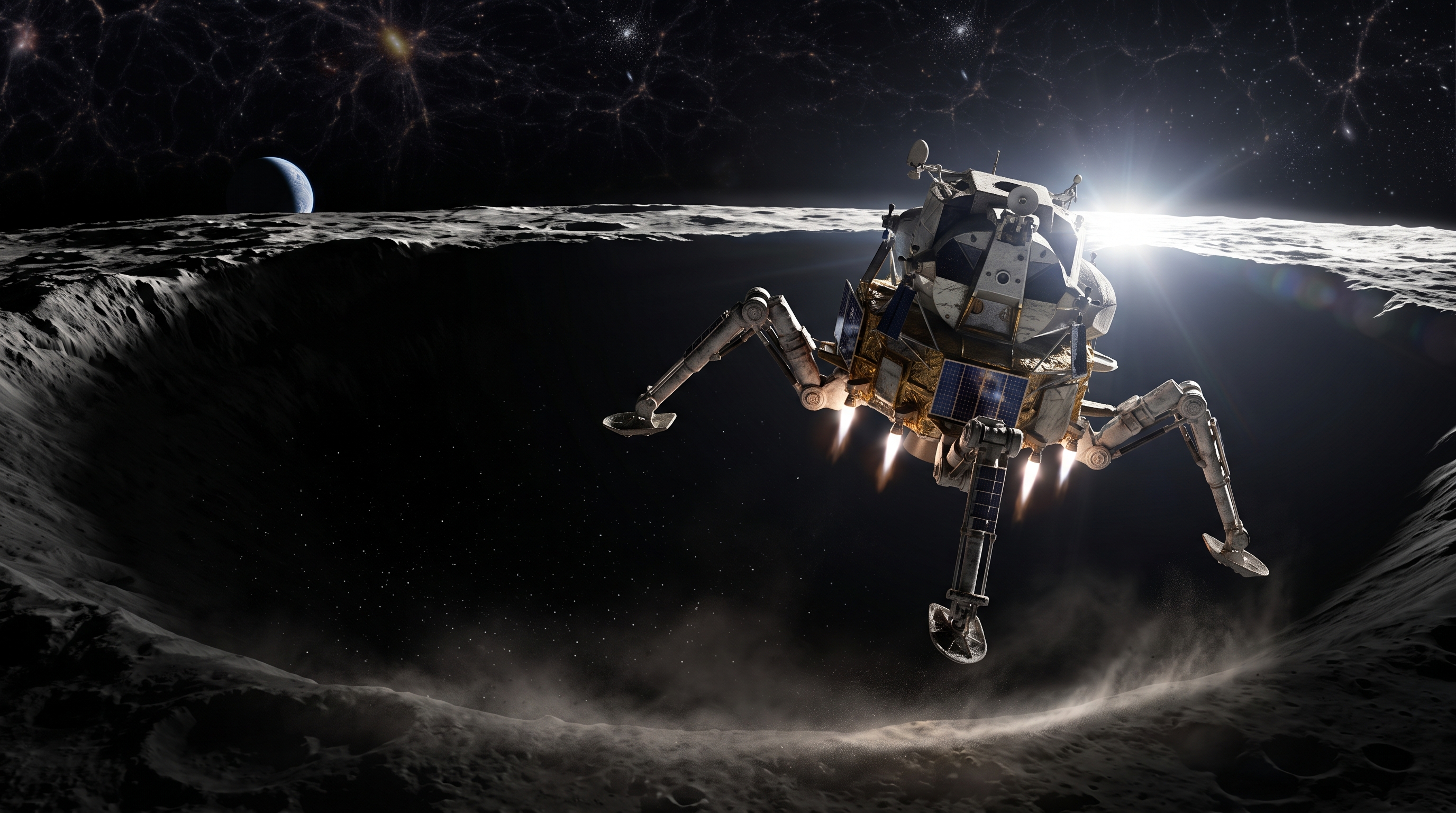
Brown University planetary scientist James Head, who has studied the Moon since the Apollo era, doesn’t undersell the mission: “Chang’e-7 is the most ambitious, comprehensive, and complex robotic lunar mission ever attempted by any nation or entity.” The claim holds up against the hardware involved. Chang’e-7 comprises four separate vehicles working together: an orbiter for communications and mapping that will remain in service for years; a lander built for up to eight years of surface operations; a rover equipped with cameras, ground-penetrating radar and soil-analysis instruments; and a six-legged, thruster-powered hopper capable of leaping up to 15 kilometers across the surface in a single bound — only the second multi-flight vehicle to operate on another world, after NASA’s Ingenuity helicopter on Mars.
The mission’s central goal is a direct, landed search for water ice — something no mission has ever actually attempted. As planetary scientist Norbert Schorghofer put it, “There has never been a landed mission to find water on the Moon.” Decades of orbital and remote sensing data suggest ice is trapped in the Moon’s permanently shadowed polar craters, but nobody has confirmed it, or measured how deep or accessible it is. Because Shackleton Crater’s interior is too steep and too dark for a rover to enter, the hopper is designed to leap in, survive briefly on its own systems, drill for ice, and leap back out — the only realistic way to physically sample ground that’s never seen sunlight.
Chang’e-7 also carries a genuinely international set of instruments, from Russia, Italy, Thailand, Switzerland, Bahrain and Egypt, plus a 1.5-kilogram telescope built by the University of Hong Kong with the International Lunar Observatory Association to capture panoramic Milky Way images from the surface. The mission sits inside China’s broader lunar roadmap: Chang’e-8 follows around 2028 to test habitat-building technology, ahead of a targeted Chinese crewed lunar landing by 2030 — the same window NASA is chasing with Artemis, with lunar water ice a key resource both programs are racing to secure.
The week in review
Starship’s Ship 40: recovered, corrected, still not home
Tuesday’s episode reported that SpaceX had completed recovery of Starship’s Ship 40, the Flight 13 upper stage that survived an unprecedented soft splashdown in the Indian Ocean on July 24. That held up only partly: fuller reporting the next day showed the ship had been towed much further than first known, arriving August 18 in sheltered waters off Christmas Island — not a mainland Australian port — after 24 days adrift and more than 400 kilometers of drift in total. SpaceX has set up a 500-metre exclusion zone around the vessel while engineers conduct closer inspections, but no plan has been announced yet for the final leg back to Starbase, Texas; at the ship’s current tow pace, that trip would take over a year, so a different transport method is clearly needed.
There’s also a related update on SpaceX’s next milestone. On August 4, during the company’s first earnings call as a public company, Elon Musk sounded optimistic about attempting a tower-catch of a returning Starship on Flight 14, then tentatively targeted for the end of August. On August 20, he posted that the catch will “probably” happen “in a few months” instead — reporting points to the need for separate FAA approval for a ship-catch attempt, rather than a technical setback, as the likely reason. Flight 14 itself is still targeted no earlier than August 28, and remains a major milestone in its own right: Musk says it will be Starship’s first-ever fully orbital flight.
China’s LandSpace sticks the landing on Zhuque-3
On August 19, Chinese commercial launch company LandSpace became the first private Chinese company to land an orbital-class rocket booster. Zhuque-3 — a 76.6-metre, stainless-steel, methane-fueled rocket taller than a Falcon 9 — lifted off from the Dongfeng Commercial Space Innovation Pilot Zone in northwestern China, and its first stage touched down on four legs roughly 390 kilometers downrange in Gansu Province about eight minutes later, landing close to dead-center on its pad. It was the rocket’s second flight; the first, in December 2025, reached orbit successfully but ended in a fiery landing failure after the booster lost an engine during its landing burn. LandSpace describes the successful landing as a shift “toward the engineering application phase of reusability” — a genuine milestone for China’s commercial space sector, which is now visibly chasing the same booster-reuse economics that transformed SpaceX.
NASA finds the crater a SpaceX rocket left on the Moon
A spent Falcon 9 upper stage — uncontrolled, leftover hardware from an earlier launch — struck the Moon’s surface on August 5. Because astronomers had tracked the stage and predicted roughly where and when it would hit, the impact became something of a race to document. South Korea’s Danuri orbiter imaged the site within hours, confirming the predicted location to within about 0.6 miles, and NASA’s Lunar Reconnaissance Orbiter followed up with detailed images on August 11 and 12, released this week with full analysis. The resulting crater is modest — roughly 60 feet wide and less than 10 feet deep — but its ejecta rays give scientists a free, precisely-dated cross-section of lunar soil at two depths, useful for calibrating how quickly the Moon’s surface weathers over time. Coordinates: 19.4759°N, 266.7138°E.
NASA’s Swift rescue mission fails
NASA’s Swift Observatory, which has tracked gamma-ray bursts since 2004, has been losing altitude faster than expected due to heightened solar activity. Facing an uncontrolled reentry before year’s end, NASA contracted Arizona-based Katalyst Space Technologies to build a rescue spacecraft, LINK, which launched July 3 and spent roughly three weeks tracking toward a rendezvous before suffering its own attitude-control failure — two of its three reaction wheels stopped working, and a thruster malfunction sent it spinning uncontrollably. NASA confirmed the rescue attempt’s failure on August 19; Swift will now reenter uncontrolled later this year, with early reporting suggesting not before October, though NASA hasn’t confirmed a firm date. LINK will still attempt a close flyby to gather data for future satellite-servicing missions. NASA Administrator Jared Isaacman: “This is not the outcome we were working toward, but it does not change why this mission was worth attempting.”
Links & sources
- Space.com — China’s Chang’e 7 moon probe will launch this weekend on the most ambitious lunar mission in history
- Scientific American — China is about to launch its most ambitious moon mission yet
- Al Jazeera — China’s new moon mission could unlock secret of lunar ice: Why that matters
- China in Space — Chang’e 7 Rolls Out Ahead of Moon Launch From Wenchang
- NASASpaceFlight.com — Ship 40 arrives at Christmas Island, plans return to Starbase
- Starlust — SpaceX finally hauls Starship’s Ship 40 to Christmas Island after 24 days lost at sea
- Space.com — SpaceX will try for 1st Starship tower catch ‘in a few months,’ Elon Musk says
- Spaceflight Now — LandSpace becomes first commercial Chinese company to land an orbital-class booster
- NASA Science — NASA’s LRO Images Falcon 9 Crater on Moon, Learns New Details
- Nature World News — NASA Says Swift Observatory Will Likely Reenter Earth’s Atmosphere This Year After Commercial Boost Mission Ends
- CBS News — NASA’s Swift telescope will plunge toward Earth after rescue mission called off