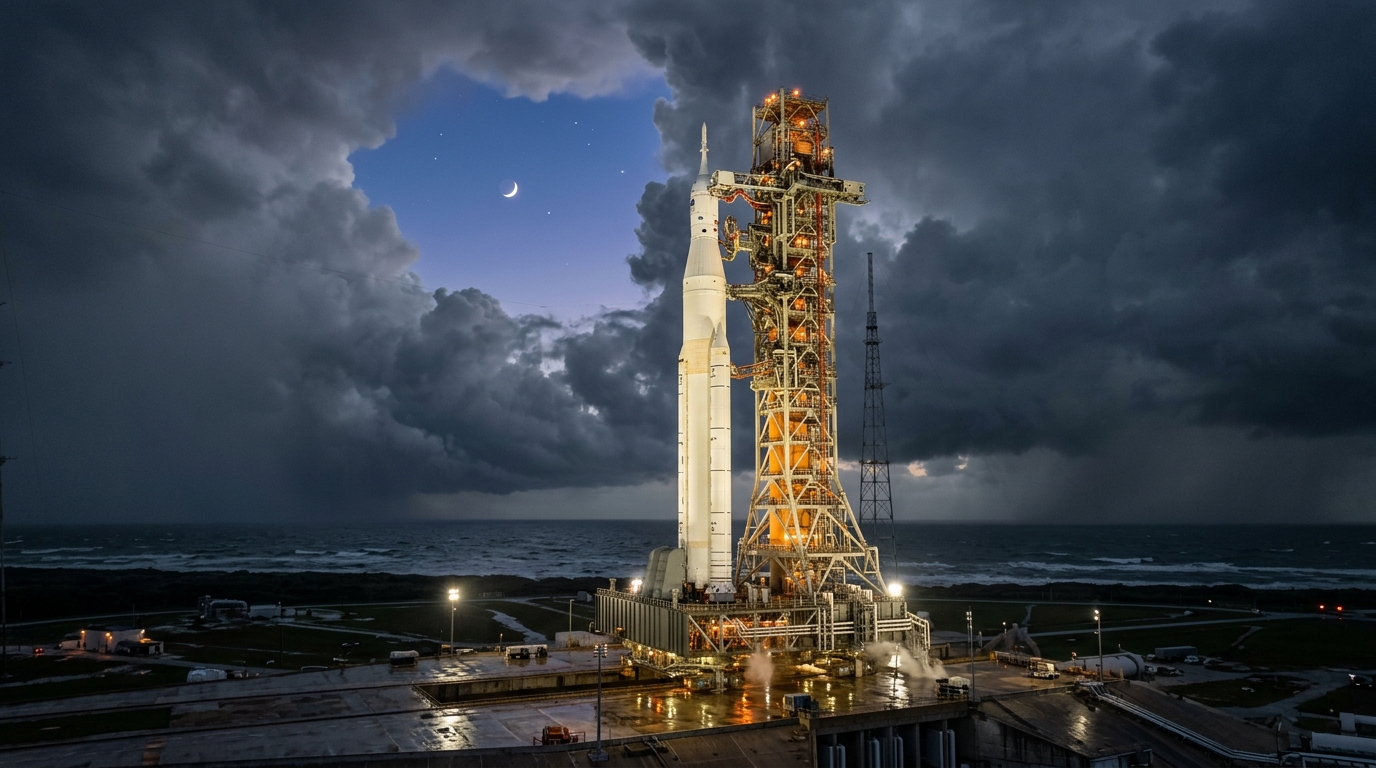
China Delays Its Most Ambitious Moon Mission Ever
Related Episode
China Delays Its Most Ambitious Moon Mission EverChang’e-7’s launch slips about a month thanks to weather and unforgiving lunar polar-landing geometry, plus a follow-up on LandSpace’s Zhuque-3 booster fire, SpaceX’s 100th launch of 2026, and a comet in outburst. S05E175
China Delays Its Most Ambitious Moon Mission Ever
Today’s episode covers a launch that didn’t happen, a landing that turned out to have a second act, a round-number milestone, and a comet worth grabbing binoculars for. Here’s the rundown, with links to everything we referenced.
China delays the Chang’e-7 launch by about a month
Chang’e-7’s launch window opened today, August 24, and ran through the 31st — but a tropical system, reported variously as Tropical Depression or Tropical Storm Narra, formed over the Gulf of Tonkin and threatened the Wenchang launch site on Hainan Island. Chinese state media, via Xinhua, cited the weather alongside a broader safety and reliability review in announcing that the mission “does not meet the launch conditions” and “cannot be carried out within the scheduled window” — without naming a new date.
For most rockets, a weather scrub means trying again within days. Chang’e-7 is different, because its target — the rim of Shackleton Crater at the lunar south pole — needs a specific combination of orbital geometry and solar illumination to make a landing possible at all. Independent trajectory analysis (via China in Space, and echoed by Thailand’s National Astronomical Research Institute) indicates this alignment recurs for only about a week at a time, roughly once a month, and is gradually shifting due to the Moon’s 18.6-year nodal cycle. The next realistic opportunity looks to be around mid-to-late September.
Some wire summaries render the official language in a way that could be misread as a delay out of 2026 entirely. Based on the corroborating trajectory analysis pointing to a roughly one-month slip, we’re reading “cannot be carried out within the scheduled window” as referring to this specific window rather than the whole year — but we’ll correct that on air if firmer reporting says otherwise. The mission itself is unchanged: an orbiter, a lander built for up to eight years of surface operations, a rover, and a six-legged hopper capable of 15km leaps, all aimed at the first-ever landed search for water ice at the lunar south pole — still, per Brown University’s James Head, “the most ambitious, comprehensive, and complex robotic lunar mission ever attempted by any nation or entity.”
LandSpace’s Zhuque-3: the landing held, the booster didn’t
Last week we reported that LandSpace had become the first private Chinese company to land an orbital-class rocket booster — a genuine milestone for China’s commercial space sector. New reporting fills in what happened right after: according to NASASpaceFlight, residual liquid methane and oxygen ignited near the booster’s base shortly after its August 19 touchdown in Gansu Province, and the resulting fire damaged one of the vehicle’s four carbon-fiber composite landing legs, causing it to topple over.
The landing itself — four legs, close to dead-center, roughly 390km downrange, about eight minutes after liftoff — still stands as reported. NASASpaceFlight’s framing also adds useful nuance: this was China’s first successful land-based recovery of an orbital-class booster using landing legs at all, not just among private companies, since the state-run Chang Zheng 10B’s July recovery used a net-catch method at sea rather than legs.
A post-landing fire is a real setback, but it’s a different — and not unprecedented — failure mode than the guidance-and-control problem that doomed Zhuque-3’s first landing attempt in December. SpaceX’s own Falcon 9 booster B1086 suffered a near-identical post-landing fire and tip-over on a droneship in March 2025. Safely venting or burning off leftover propellant after touchdown is its own engineering challenge, separate from the landing itself, and it’s one every methane-fueled reusable booster program is still working through. LandSpace’s own description of this flight as a step “toward the engineering application phase of reusability” holds up — this is what that transition actually looks like: the hardest problem solved, and the smaller ones now surfacing.
SpaceX flies its 100th mission of 2026
On August 22, a Falcon 9 carrying 27 Starlink satellites lifted off from Vandenberg Space Force Base — SpaceX’s 100th orbital launch of the year, 99 of them Falcon 9 flights plus one Falcon Heavy mission back in April. The satellites deployed on schedule about 62 minutes after liftoff, and the booster — flying its ninth mission — landed cleanly on a droneship in the Pacific. Seventy-six of this year’s 99 Falcon 9 flights have been dedicated Starlink missions, and the constellation has now passed 11,000 operational satellites. SpaceX’s full-year record remains 165 launches, set in 2025.
Tonight’s Sky: Comet 220P in outburst
Comet 220P/McNaught, a periodic comet orbiting the Sun roughly every five years between Mars and Jupiter, has gone through two outbursts this year, brightening by an estimated 20,000 times its normal level — enough to bring it within reach of binoculars rather than requiring a telescope. It shows a distinctive green head, from fluorescing diatomic carbon, and a short dust tail; the cause of the outbursts is unknown, with a sudden release of subsurface gas or a “comet quake” among the leading guesses. It’s expected to fade after passing about one Earth-Sun distance from us in October, so the next few weeks are the best window to catch it. Also on the calendar: a 96%-partial lunar eclipse the night of August 27–28 — full viewing details to come as it gets closer.
Links & sources
NASASpaceFlight.com — LandSpace’s Zhuque-3 Topples After Landing
Space.com — Bad weather delays launch of China’s historic Chang’e 7 mission to moon’s south pole
SCMP — China puts Chang’e-7 mission to lunar south pole on hold
SpaceNews — China delays Chang’e-7 lunar south pole landing mission launch
China in Space — Chang’e 7 Moon Mission Delayed by One Month
CNN — China postpones launch of unprecedented water-hunting moon mission amid space race
Space.com — SpaceX sends 27 Starlink satellites to orbit on 100th Falcon rocket launch of the year
APOD — Comet 220P in Outburst (August 24, 2026)