Betelgeuse Was Never Alone
Related Episode
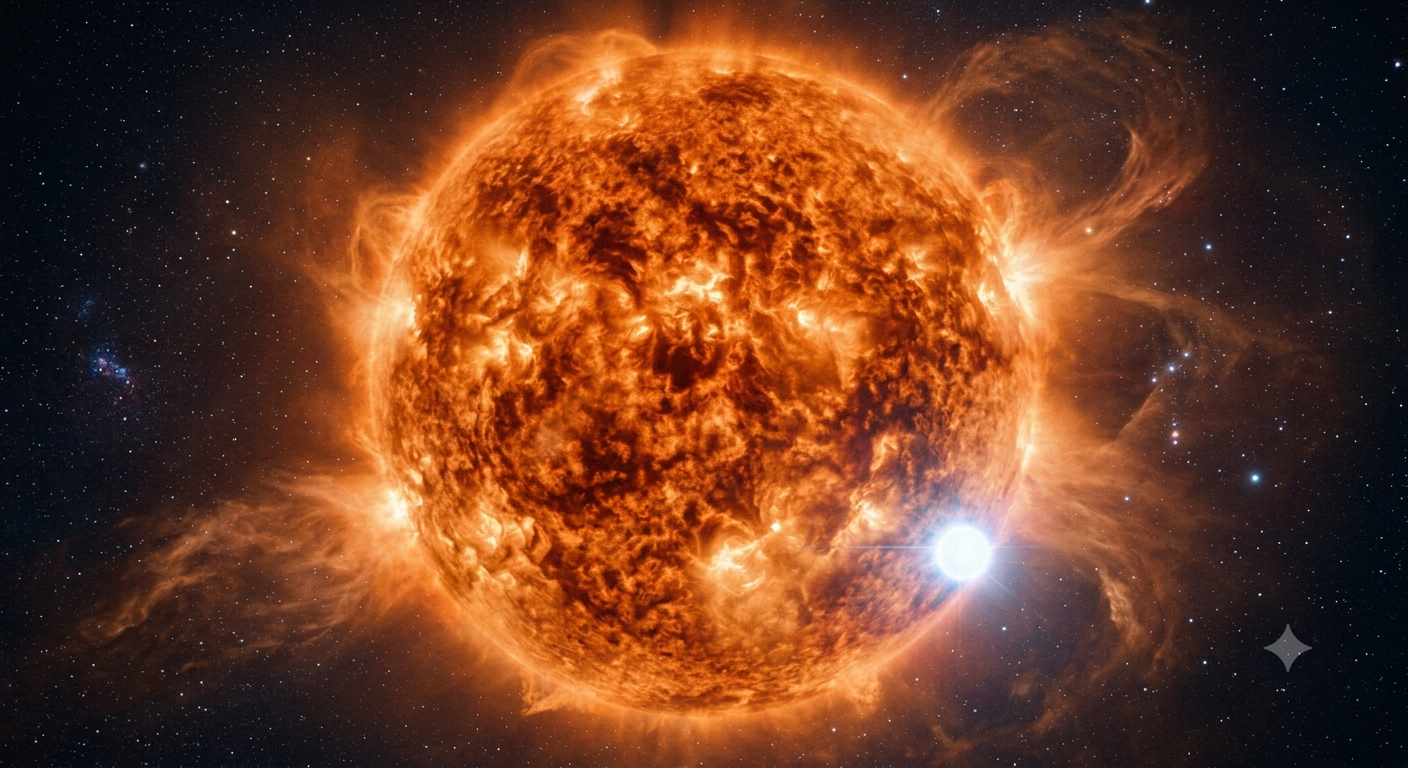
Betelgeuse Is Not Alone!Look up at Orion on any clear night and you have already met the star at the centre of this week’s biggest astronomy story. Betelgeuse — the deep-orange point marking the hunter’s shoulder — is a red supergiant so vast that, dropped into our own solar system, it would engulf the orbit of Jupiter. For more than a thousand years, people have noticed that it flickers, brightening and fading on a tangle of overlapping cycles. And for almost a hundred of those years, astronomers have wondered whether one of those rhythms could be explained by a second star, hidden in the glare.
This week, they finally caught it. A team led by Miguel Montargès at the Paris Observatory used the Very Large Telescope in Chile — and its glare-suppressing SPHERE instrument — to capture the clearest direct image yet of what is very likely Betelgeuse B, the supergiant’s long-suspected companion. The result was published on 28 July in Astronomy & Astrophysics. As Montargès put it, this is the conclusion of a century-long quest.
The reason it took a century comes down to a simple, cruel problem of contrast. Betelgeuse is overwhelmingly bright and physically enormous; any modest companion sitting close beside it is like a candle held up next to a lighthouse. To beat the glare, the team timed their observation for December 2024 — the moment in the orbit when the companion swings as far from Betelgeuse as it ever appears from Earth — and then relied on a happy surprise. The companion, predicted to be roughly the mass of our Sun, turned out to be larger, perhaps two to three solar masses. Brighter than expected, it just peeked clear of the light.
That companion is no supergiant — think instead of a young, hot, fairly ordinary star locked in an uncomfortably tight orbit, close enough to skim the outer layers of Betelgeuse itself. That orbit almost certainly paces the mysterious six-year beat in Betelgeuse’s brightness. It may also spell the companion’s doom: dragging through a supergiant’s atmosphere bleeds away orbital energy, and models suggest the smaller star is slowly spiralling inward, destined — over many thousands of years — to be swallowed.
Why does any of this matter beyond a nice picture? Because Betelgeuse is the sky’s most famous ticking clock. It is old, massive, and fated to explode as a supernova — briefly outshining every other star — sometime in the next hundred thousand years or so. Whether a star has a close binary companion changes how it sheds mass, sculpts the gas around it, and ultimately detonates. Learning that Betelgeuse is a pair, not a loner, quietly rewrites part of that ending.
It was not the only reminder this week that the universe keeps its most dramatic objects well hidden. NASA’s Swift observatory helped confirm a tidal disruption event — a black hole tearing apart a passing star — with one very strange feature: it happened around 30,000 light-years from its galaxy’s core, the most off-centre such event ever recorded. The flare, briefly as bright as ten billion Suns, betrayed a “wandering” black hole of about a million solar masses, roaming far from the centre where big black holes usually sit. Flagged first by a robotic sky survey and picked out by an AI sifting half a million nightly flashes, it is a preview of the census of hidden black holes that new observatories will soon make routine.
Two more threads rounded out the day. NASA’s Nancy Grace Roman Space Telescope was fuelled on 25 July and is now one month from a 30 August launch — running months ahead of schedule and promising to survey the sky at Hubble sharpness but on an industrial scale, chasing dark energy and an expected haul of more than 100,000 exoplanets. And there was a sting in the tail for Swift: the commercial spacecraft sent to boost the ageing observatory out of a decaying orbit, Katalyst’s LINK, began spinning over the weekend after losing two of its three reaction wheels. Its team is working to steady it before deciding whether the rescue can still go ahead. The same little telescope that just helped find an invisible black hole is now waiting to learn whether its own lifeboat can reach it.
None of which changes what you can do tonight. Step outside — mind the brilliant full Buck Moon — and, before dawn, find Orion climbing in the east. Look for that orange shoulder. It is the same star humans have watched for millennia, and it looks exactly as it always has. But you now know something they never did: it was never alone.
Read more, explore the full archive and subscribe to the daily newsletter at astronomydaily.io.