A World in Three Parts | Astronomy Daily · S05E155 · Friday 31 July 2026
Related Episode
Three of a KindAsk most people to picture an asteroid and they’ll describe a potato — a single grey lump tumbling through the dark. It’s a fair image. Most asteroids really are lonely, irregular rocks. Some are “contact binaries,” two lobes fused into a peanut shape, like the comet Rosetta visited or the little moonlet DART crashed into. But this week, one long-known asteroid broke the mould entirely.
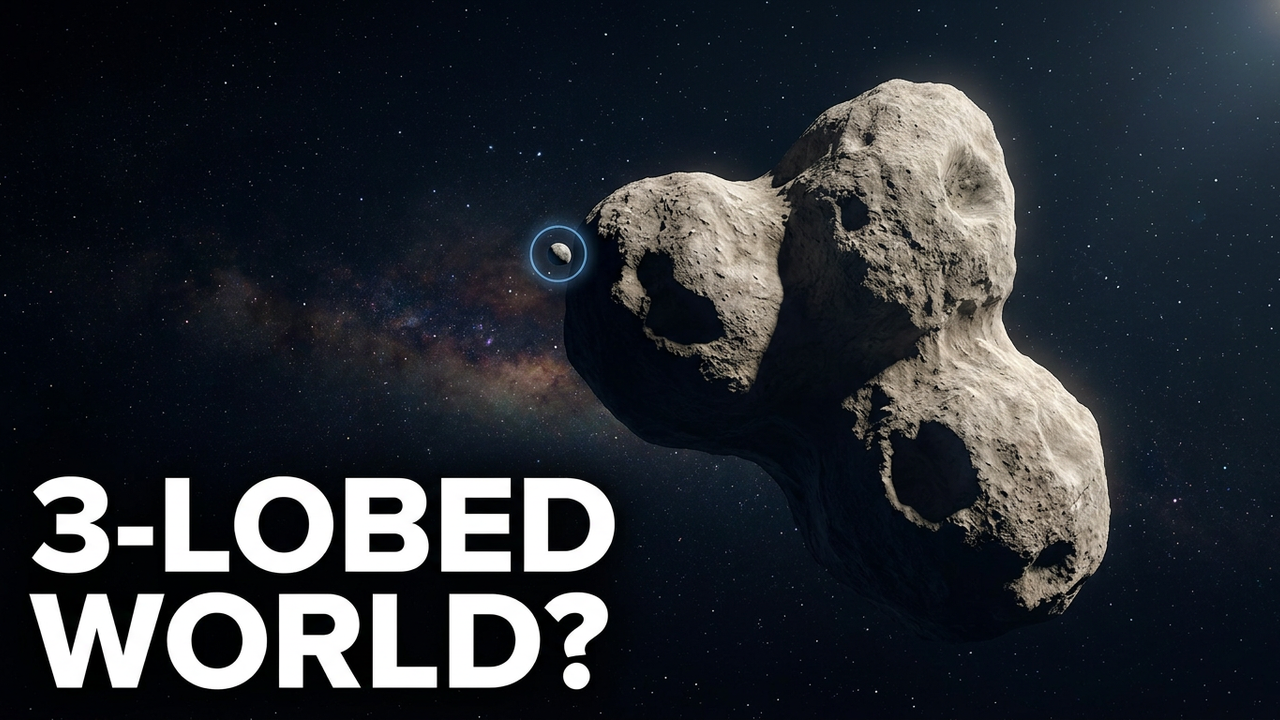
Asteroid (44) Nysa has been on our books since 1857. It is one of the brightest asteroids in the main belt, a member of the uncommon “E-type” family whose enstatite-rich surfaces gleam unusually white, and at about seventy-five kilometres across it is one of the largest of its kind. For years its shape teased astronomers: earlier data hinted it might be two lobes stuck together. New imaging says the truth is stranger. Nysa appears to have three.
A team led by Kate Minker at Lowell Observatory — in a paper cheerfully titled “Unmasking (44) Nysa” — used two of the sharpest instruments on Earth to look. The Large Binocular Telescope in Arizona, whose mirror dwarfs Hubble’s, carried an instrument called SHARK-VIS; the Very Large Telescope in Chile added its own view. Both lean on adaptive optics, flexing a mirror hundreds of times a second to cancel the atmosphere’s blur in real time, and both nights — one in February, one in March — showed the same three-part silhouette: three lobes joined by two narrow necks. If it holds up, it is the first “trilobate” asteroid ever seen.
Then came the second surprise. Nysa has a moon. It is small — roughly a kilometre wide — and it orbits at least a hundred and seventy kilometres out, and it had been hiding in plain sight, swamped by the far brighter asteroid beside it. To dig it out, the team borrowed a technique from a completely different field: the high-contrast imaging used to prise faint planets from the glare of their stars. Because they caught the moon shifting position across two observing runs, they know it is genuinely in orbit.
That little moon is more than a bonus. Watch how quickly it circles and how far out it sits, and you can weigh Nysa — and from its mass and size, calculate its density. Density is the tie-breaker. A genuine three-part body — a “contact trinary” of chunks gently merged — should read differently from a single, solid rock that merely looks three-lobed from our vantage point. The moon, in other words, is the tool that will tell us what kind of world Nysa really is, and how it came to be so odd.
It is a quietly humbling story. Here is an object found in the middle of the nineteenth century, studied for generations, and it still had two secrets left in 2026 — a shape nobody expected and a moon nobody had seen. The solar system, even the parts we think we know, is not finished with us.
The rest of today’s episode leans into that same spirit of looking harder. NASA has just funded a genuinely audacious concept — Paul Stankus’s “Mapping Alien Continents” — that aims not merely to detect an Earth-like exoplanet but to resolve its surface, its continents and oceans, in visible light. The trick is to fly two light-cancelling instruments on separate spacecraft about a hundred kilometres apart and combine them into a single vast telescope. It is early-stage and may never fly in this form, but it is exactly how the big leaps begin: someone asks whether we could actually look, and is handed a little funding to find out.
And running through the back half of the show is a single thread: the solar wind. A batch of solar storms is brushing past Earth as we publish, with the potential for minor geomagnetic storms and auroras at high latitudes in both hemispheres. That same wind, gentle here because our magnetic field and atmosphere shrug it off, is the subject of NASA’s Mars-bound ESCAPADE mission — twin spacecraft, currently loitering near the L2 point, that recently turned their cameras home for a luminous Earth-and-Moon portrait before setting out to study how the wind has scoured Mars of its air. The wind that paints our sky, and the wind that stripped a planet. Same Sun.
Full episode, images and links: astronomydaily.io. Clear skies.