A Hundred and Nine Flashes
Related Episode
A Hundred and Nine FlashesAstronomy Daily companion blog · S05E190 · Thursday, 10 September 2026 · astronomydaily.io
A hundred and nine radio flashes, each lasting a thousandth of a second, have just been used to weigh the ordinary matter of the universe — and they found more of it than the X-ray surveys could see.
A fast radio burst is barely an event. It arrives, releases in a millisecond roughly what the Sun puts out in a couple of days, and is gone. The first was picked out of archived Parkes data in 2007, and for years the field argued about whether it was real. Thousands are now known, and at least some come from magnetars — but the most interesting thing about a fast radio burst has turned out not to be what makes it. It is what happens to it on the way here.
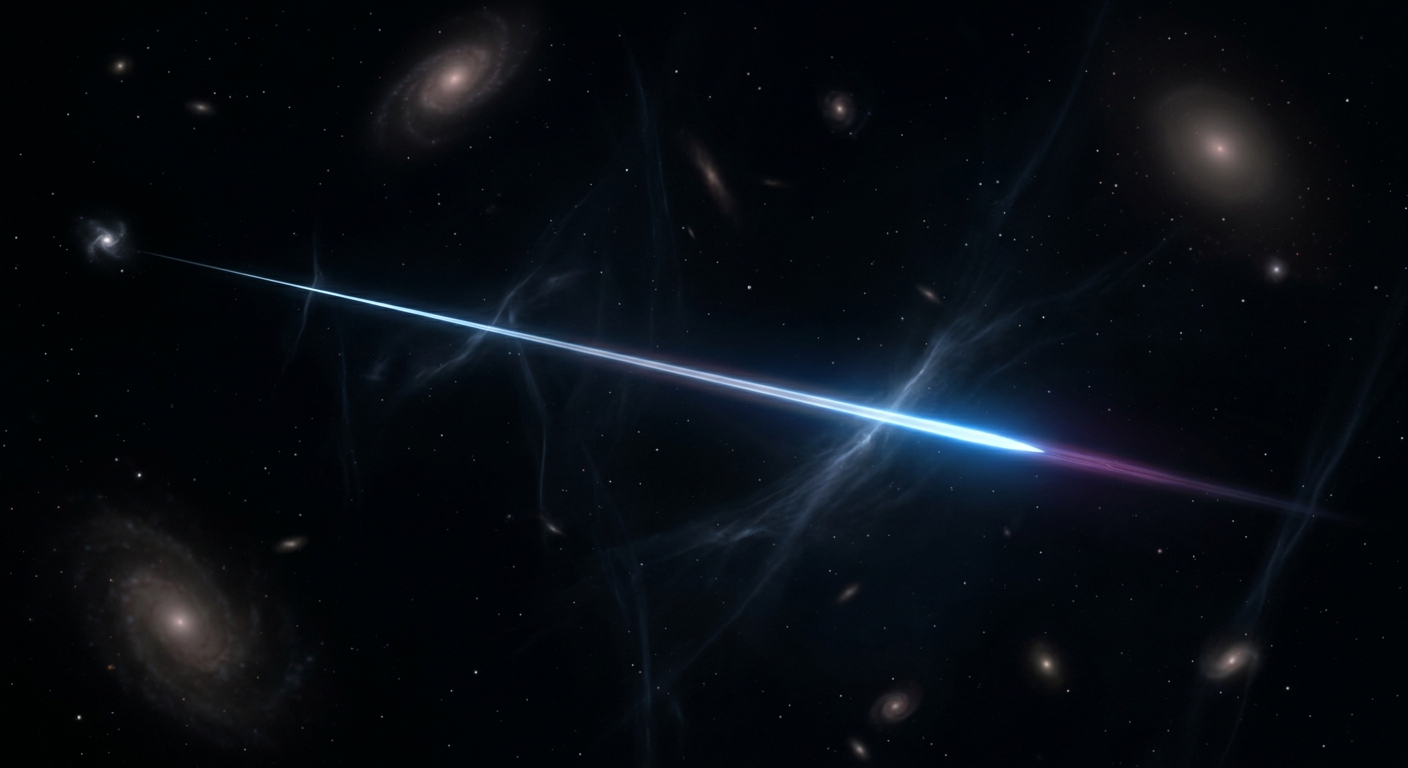
The pulse contains a spread of radio frequencies that all leave at the same instant, and the space it crosses is not empty: there is a thin haze of free electrons between the galaxies, and free electrons slow low frequencies slightly more than high ones. So the burst arrives stretched. That smear is called the dispersion measure, and its size is a count of the electrons the pulse passed through — not the distance travelled, but the amount of matter in the way. Every burst is a core sample of the universe along one line of sight.
The problem this already solved
That instrument settled an old embarrassment. The cosmic microwave background tells us how much ordinary matter the universe was built with; add up everything visible, and about a third was unaccounted for. The suspicion was that it lay between the galaxies, too thin and too cool to glow in X-rays — precisely the material a dispersion measure notices whether it glows or not. In 2020 a team led by Jean-Pierre Macquart, at the Curtin node of ICRAR, used ASKAP in Western Australia to localise bursts to their host galaxies and compare dispersion against distance. The missing matter was there. The relationship carries his name; Macquart died that same year, at forty-five, months after the paper appeared.
The problem that was left
Knowing the matter exists is not the same as knowing where it sits, and the difference matters more than it sounds. Galaxies do not hold on to their gas. Supernovae, and more forcefully the supermassive black holes at galactic centres, drive outflows that push material millions of light years out. Caltech’s Vikram Ravi describes the effect as thinning the gas around galaxies and smoothing out the clumps — and, he adds, it does so in a way that looks astonishingly similar to what massive neutrinos would do, or what some dark energy and dark matter theories predict.
That is not a footnote. How lumpy the universe is on different scales is one of the sharpest tests available of what it is made of, and there has been a long-standing disagreement — the S8 tension — between the lumpiness the early universe implies and the lumpiness late-time surveys measure. Either that gap is new physics, or it is our ignorance about how much gas galaxies throw around. Nobody could settle it, because nobody could measure the diffuse gas well: X-ray telescopes see the hot component and miss the cool, and the microwave technique is statistical and difficult. What was wanted was something that counts electrons and does not care how hot they are.
A hundred and nine core samples
That is what appeared in Nature Astronomy on 8 September. A team led by Kritti Sharma at Caltech, with Vikram Ravi, Liam Connor and Elisabeth Krause at the University of Arizona among the co-authors, took 109 fast radio bursts localised to host galaxies out to redshift 0.3 — most of them from Caltech’s DSA-110 array at Owens Valley — and used them to measure how far feedback has suppressed the clustering of matter, and how much gas is actually retained by groups and clusters weighing between 10^13 and 10^15 solar masses.
There is more of it than the X-ray picture implied. The gas fractions come out about 1.9 sigma above stacked eROSITA measurements of comparable systems, and slightly above the Atacama Cosmology Telescope’s kinetic Sunyaev–Zel’dovich constraints — consistent with the bursts counting cool gas that simply does not shine. And the precision is the part that made the field sit up: using the bursts cut the uncertainty on clustering at these scales by roughly a factor of eight, delivering a constraint competitive with two enormous surveys. As Krause put it, this is amazing considering they only had about a hundred bursts in the sample — and it is only the beginning.
The honest caveats
A hundred and nine is a small sample, and a 1.9-sigma difference is interesting rather than settled. Part of every dispersion measure comes from the host galaxy and has to be modelled; the team derive an average host contribution of about 129 pc cm⁻³, give or take nearly twenty, and that modelling is the weakest joint in the chain. And this is a low-redshift sample: it says a great deal about the recent universe and much less about the deep past.
The fix is volume, and it is being built: Caltech’s full Deep Synoptic Array, planned for a Nevada valley with construction targeted around 2029, should find these in the tens of thousands, at a projected precision on the clumpiness parameter of around 0.006 — the level at which you stop arguing about whether a tension exists and start reading off an answer.
It is worth noticing where this technique comes from and where it still lives. The first burst came out of Parkes. The Macquart relation came out of ASKAP, on Wajarri country at Inyarrimanha Ilgari Bundara, and ASKAP remains one of the most productive burst-localising instruments anywhere; MeerKAT works the same problem from South Africa. Both sites are the foundations of the Square Kilometre Array. A phenomenon that was one unexplained blip in an Australian archive nineteen years ago is now a cosmological instrument — and a hundred and nine of them have just landed a punch in an argument that giant surveys have been having for a decade.